
By Afla KC , Digital Marketing Executive
Employee onboarding is more than introducing a new employee to the team.
It is the process through which a new employee moves from offer acceptance to becoming a fully integrated member of the organization. During this stage, HR collects important information, completes employment formalities, communicates company policies and ensures that the employee has everything required to begin their role.
Because onboarding involves multiple activities, proper documentation is essential.
A well-documented onboarding process helps HR maintain accurate employee records, avoid missing important information, create consistency across departments and provide a clear record of what was completed.
So, what exactly should an HR team document during employee onboarding?
1. Offer and Appointment Documentation
The onboarding record should begin with the documents that establish the employee’s employment relationship with the organization.
Depending on the company’s process, this may include:
Offer letter
Appointment letter
Employment agreement
Job description
Compensation details
Joining date
Designation
Department
Reporting manager
Employment type
Probation terms, where applicable
These documents should clearly communicate the key terms and conditions of employment.
HR should maintain the final version of the documents issued and any required acceptance or acknowledgement.
2. Employee Personal Information
HR should create a standardized employee profile containing the information needed to manage the employment relationship.
This can include:
Full name
Date of birth
Contact number
Email address
Current address
Permanent address
Emergency contact
Employment-related identification details
Only information that is genuinely required should be collected, and employee data should be handled according to applicable privacy and data-protection requirements.
A standardized employee information form can make this process easier.
3. Identity and Eligibility Documents
Depending on the employee’s role, location and applicable requirements, HR may need to collect documents that verify identity or eligibility.
These may include relevant:
Identity documents
Address documents
Educational certificates
Professional certifications
Previous employment records
Experience certificates
Other role-specific documents
HR should define which documents are actually required instead of collecting unnecessary personal information.
Document requirements can vary by organization and employment category.
4. Bank and Payroll Information
Payroll-related information should be collected before the employee’s first salary cycle whenever possible.
The onboarding record may include:
Bank account details
Required tax-related information
Salary structure
Allowances
Reimbursement information
Applicable declarations
Other payroll inputs
This information should be verified carefully because incorrect payroll details can cause payment delays or calculation issues.
Access to salary and banking information should also be restricted to authorized personnel.
5. Statutory and Benefits-Related Information
HR may need to collect or record information required for applicable statutory benefits, payroll deductions or employee benefit programs.
Depending on the employee and organization, this may relate to areas such as:
Provident Fund
ESI
Professional Tax
Tax declarations
Insurance
Gratuity-related records
Other applicable employee benefits
The exact documentation depends on the employee’s eligibility, organization, location and applicable regulations.
HR teams should review current requirements rather than relying on an old onboarding template.
6. Job Description and Role Expectations
Onboarding documentation should not focus only on personal and payroll information.
HR should also document what the employee has been hired to do.
This may include:
Job title
Key responsibilities
Reporting structure
Department
Key performance areas
Initial objectives
Working hours
Work location
Probation expectations
A clear job description gives both the employee and manager a common understanding of the role.
It can also become useful later during performance discussions.
7. Company Policies and Employee Acknowledgements
New employees should be introduced to the policies that apply to their role and workplace.
Depending on the organization, these may include policies related to:
Attendance
Leave
Working hours
Remote or hybrid work
Code of conduct
Information security
Data protection
Anti-harassment
Workplace safety
Acceptable technology use
Confidentiality
HR should maintain a record showing which policies were provided or acknowledged by the employee.
The exact policies required will vary by organization and applicable law.
8. Confidentiality and Data Protection Documents
Some employees may have access to confidential company, customer or business information.
Where applicable, HR should document relevant confidentiality commitments or agreements.
This could cover areas such as:
Business information
Customer information
Pricing
Internal processes
Intellectual property
Company data
Confidential documents
Employees should also understand their responsibilities regarding company information and approved systems.
The documentation should reflect the organization’s actual legal and operational requirements rather than using generic clauses without review.
9. IT and System Access Records
Modern onboarding often involves setting up several digital accounts.
HR should coordinate with IT or the relevant department to document:
Company email
HRMS account
CRM access
Project management tools
Communication platforms
Software licenses
VPN access
Other role-specific systems
The record should show what access was requested, approved and provided.
For security reasons, HR should not maintain employee passwords in onboarding files.
Access should be managed through the organization’s approved IT and security processes.
10. Company Assets Issued
If the organization provides equipment or other assets, the details should be documented.
For example:
Laptop
Desktop
Mobile phone
ID card
Access card
SIM card
Headset
Uniform
Tools or equipment
The asset record can include:
Asset → Serial Number/Identifier → Employee → Date Issued → Condition → Acknowledgement
This documentation becomes particularly useful during employee exit and asset recovery.
11. Orientation and Training Records
Onboarding documentation should also capture the training provided to the employee.
This may include:
Company orientation
HR policy orientation
Role-specific training
Software training
Safety training
Compliance training
Product training
Information security training
HR can record the:
Training topic
Date
Trainer
Employee attendance
Completion status
Required follow-up
This helps ensure that onboarding is more than a document-collection exercise.
12. Manager and Team Introduction
Although this may not always require a formal document, HR can maintain a simple onboarding checklist confirming that key introductions have taken place.
For example:
Reporting manager introduced
Team introduced
Department explained
Workplace/process orientation completed
Key stakeholders introduced
Initial responsibilities discussed
A consistent checklist helps prevent important onboarding activities from being forgotten.
13. Probation and Initial Review Details
If the employee is subject to a probation period, HR should record the relevant details.
This can include:
Probation start date
Probation duration
Review date
Confirmation criteria
Manager responsible for review
Review status
Confirmation decision
Keeping these dates organized helps HR and managers complete probation reviews on time.
14. Employee Emergency Contact
Emergency contact information can be important for workplace administration and employee welfare.
The onboarding record may include:
Emergency contact name
Relationship
Contact number
Relevant additional information required by company policy
Access to this information should be limited to authorized personnel and handled appropriately.
15. Employee Acknowledgement of Onboarding Completion
At the end of onboarding, HR can maintain a record confirming that the key onboarding activities have been completed.
This could include confirmation of:
Employment documents
Policies
Required personal information
Payroll setup
System access
Company assets
Orientation
Required training
A simple onboarding completion checklist gives HR a clear record of what has been completed and what remains pending.
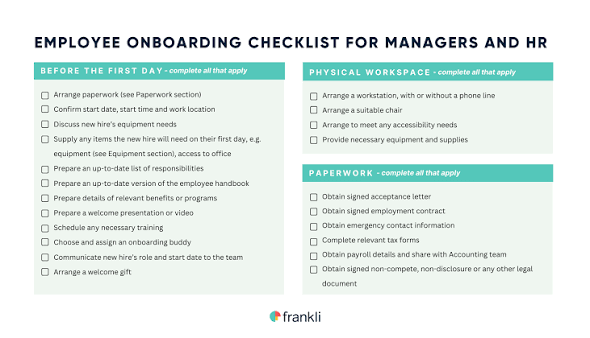
Employee Onboarding Documentation Checklist
HR teams can use this as a quick reference:
Documentation / ActivityCompletedOffer letter☐Appointment/employment documents☐Job description☐Employee personal information☐Required identity documents☐Educational/professional documents☐Bank and payroll details☐Statutory/benefit information☐Company policies shared☐Policy acknowledgements☐Confidentiality documentation☐IT/system access☐Company assets issued☐Orientation completed☐Role-specific training☐Manager/team introduction☐Probation details recorded☐Emergency contact☐Onboarding completion confirmed☐
Common Onboarding Documentation Mistakes
Even organizations with an onboarding process can make documentation mistakes.
1. Collecting Documents Without a Checklist
When there is no standard checklist, different HR team members may follow different processes.
A standardized checklist improves consistency.
2. Keeping Information in Multiple Places
If employee information is spread across emails, spreadsheets and physical files, updating records becomes difficult.
A centralized HR system can reduce duplication.
3. Collecting More Information Than Necessary
HR should avoid collecting personal information simply because it appears on an old form.
Every data field should have a clear business or legal purpose.
4. Forgetting Policy Acknowledgements
Simply sending a policy is different from maintaining a record that the employee received or acknowledged it, where acknowledgement is required.
5. Not Updating the Employee Record
An employee may complete onboarding, but if HR does not update the HRMS or employee file, the organization can still have incomplete records.
How HRMS Can Improve Onboarding Documentation
Managing onboarding manually becomes increasingly difficult as the organization grows.
An HRMS can help centralize employee information and create structured onboarding workflows.
A typical digital workflow could look like:
Offer Accepted → Employee Information → Document Collection → Policy Acknowledgement → Payroll Setup → System Access → Training → Onboarding Completed
Depending on the HRMS, HR can also use automated reminders for pending documents or approvals.
This gives HR better visibility into onboarding progress.
Instead of asking:
“Has this employee completed onboarding?”
HR can check the status of the onboarding workflow.
What Should HR Keep in the Employee File?
A good employee file should contain the records necessary to manage the employment relationship and meet applicable organizational or legal requirements.
However, not every piece of information needs to be stored in the same location.
For example:
HR File: Employment and HR records
Payroll System: Salary and payroll information
IT System: Access and security records
Asset Register: Company equipment
HRMS: Central employee profile and workflow information
Separating information appropriately can improve both organization and access control.
Final Thoughts
Employee onboarding creates the foundation for an employee’s journey within an organization.
Good documentation helps HR establish that foundation clearly.
From employment documents and employee information to policies, payroll details, system access, training and asset records, each part of the onboarding process should have a clear purpose and ownership.
The objective is not to create unnecessary paperwork.
It is to ensure that the right information is collected, the right processes are completed and the right records are maintained.
For growing organizations, moving onboarding documentation into an HRMS can make the process more consistent, trackable and scalable.
A well-documented onboarding process benefits not only HR, but also managers, employees, payroll teams, IT teams and the organization as a whole.
SEO Keywords
Primary Keywords: Employee Onboarding Documentation, HR Onboarding Checklist, Employee Onboarding Process
Secondary Keywords: HR Onboarding Documents, Employee File Checklist, New Employee Documentation, HRMS Onboarding, Employee Records, HR Documentation, Employee Onboarding Checklist, HR Process Automation