by Naziha , Digital Marketing Executive
As a business grows, managing everyday operations becomes more challenging. Tasks that were once handled informally through conversations, emails, or individual experience can quickly become difficult to control.
What happens when the person responsible for payroll is on leave? How does a new HR executive know the correct employee onboarding process? Who is responsible for checking statutory compliance deadlines? What steps should be followed when an employee resigns?
Without a clear process, employees may handle the same task in different ways. This can lead to delays, errors, confusion, and compliance risks.
This is where Standard Operating Procedures (SOPs) become important.
SOPs provide businesses with clear, documented instructions for completing routine processes. They help employees understand what needs to be done, how it should be done, who is responsible, and when it should be completed.
For critical functions such as HR and payroll, well-designed SOPs can improve consistency, reduce errors, and strengthen compliance.
This article explains why SOPs are important for businesses and how they can improve HR and payroll operations.
What Is a Standard Operating Procedure (SOP)?
A Standard Operating Procedure (SOP) is a documented set of step-by-step instructions that explains how a specific business process should be completed.
An SOP creates a standard method for performing recurring tasks.
For example, an HR onboarding SOP may explain:
-
When employee documents should be collected.
-
Who verifies the documents.
-
How employee information should be entered into the HR system.
-
When statutory registrations should be completed.
-
Who conducts the employee induction.
Similarly, a payroll SOP may explain the process for:
-
Collecting attendance data
-
Reviewing leave records
-
Calculating salary
-
Processing deductions
-
Reviewing payroll
-
Approving salary payments
The goal is to ensure that important processes do not depend entirely on one person’s memory or experience.
Why Are SOPs Important for Businesses?
Every organization has processes, whether they are documented or not.
The difference is that undocumented processes often exist only in the minds of employees.
When those employees leave the company, change roles, or are unavailable, the organization may struggle to continue the process correctly.
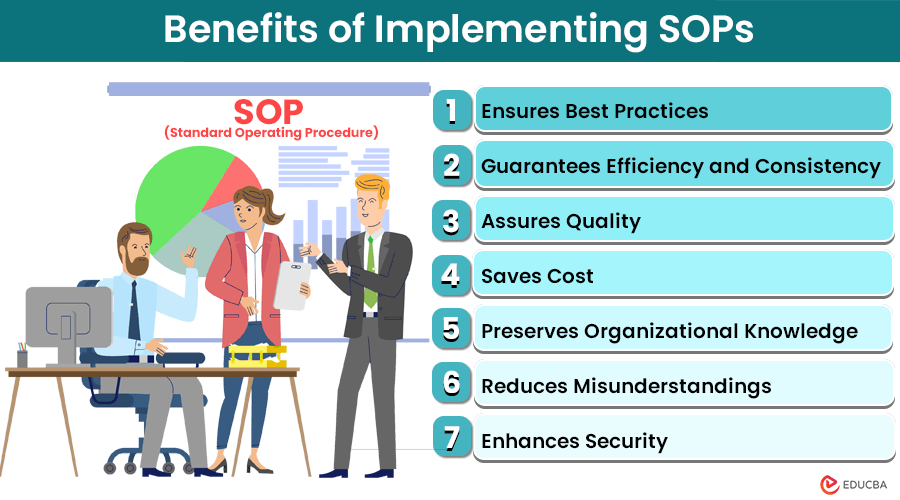
SOPs help convert individual knowledge into an organized and repeatable business process.
1. SOPs Create Consistency
One of the biggest benefits of SOPs is consistency.
Without documented procedures, different employees may complete the same task differently.
For example, imagine three HR executives onboarding new employees.
One collects all documents before the joining date.
Another collects them after the employee joins.
The third forgets to collect certain documents entirely.
This inconsistency can create serious documentation and compliance problems.
An onboarding SOP ensures that every HR team member follows the same basic process.
Example
Without an SOP:
“Collect the required documents when possible.”
With an SOP:
“Collect identity, address, bank, and employment documents before or on the employee’s joining date. Verify completeness using the onboarding checklist and upload approved records to the HR system.”
The second approach is clearer, easier to monitor, and more consistent.
2. SOPs Reduce Dependency on Individual Employees
Many businesses depend heavily on the knowledge of specific employees.
For example:
-
One payroll executive knows all payroll calculations.
-
One HR manager understands the complete onboarding process.
-
One employee knows how statutory filings are managed.
But what happens when that person leaves?
Without documentation, important business knowledge can leave with them.
SOPs help preserve institutional knowledge.
A new employee can understand the process by reviewing the documented procedure rather than relying entirely on verbal instructions.
This is especially valuable for:
-
Growing businesses
-
Companies with employee turnover
-
Small HR teams
-
Businesses with multiple locations
3. SOPs Improve HR Compliance
HR departments handle many processes that may involve legal and statutory requirements.
These may include:
-
Employee documentation
-
Payroll processing
-
PF contributions
-
ESI contributions
-
TDS deductions
-
Leave management
-
Employee exit procedures
A missed step can create compliance problems.
For example, a payroll SOP can include a monthly checklist:
✔ Collect attendance data ✔ Review leave adjustments ✔ Verify salary revisions ✔ Check PF and ESI eligibility ✔ Calculate deductions ✔ Review TDS ✔ Obtain payroll approval ✔ Process salary payments
A structured checklist reduces the risk of important steps being forgotten.
4. SOPs Reduce Errors in Payroll Processing
Payroll is one area where even a small mistake can create major problems.
Incorrect salary calculations can result in:
-
Employee complaints
-
Incorrect deductions
-
Statutory compliance issues
-
Salary payment delays
A payroll SOP provides a structured process for handling each payroll cycle.
For example:
Step 1: Collect attendance data
Collect approved attendance and leave information before the payroll cut-off date.
Step 2: Review employee changes
Check for:
-
New employees
-
Resignations
-
Salary revisions
-
Promotions
-
Unpaid leave
-
Incentives or bonuses
Step 3: Process salary calculations
Calculate:
-
Gross salary
-
Deductions
-
Statutory contributions
-
TDS
-
Net salary
Step 4: Conduct a review
A designated person should verify the payroll before final approval.
This simple process can significantly reduce payroll errors.
5. SOPs Make Employee Training Easier
Training new employees can take significant time.
Without documented procedures, new employees may repeatedly ask experienced team members questions such as:
-
“What do I do next?”
-
“Where should I save this document?”
-
“Who approves this?”
-
“What is the deadline?”
SOPs provide a clear reference.
Instead of explaining the same process repeatedly, managers can provide the employee with the relevant SOP.
This helps new employees:
-
Understand their responsibilities
-
Learn processes faster
-
Reduce mistakes
-
Become productive more quickly
However, SOPs should support training rather than completely replace it.
Employees may still need guidance for complex or unusual situations.
6. SOPs Improve Accountability
A good SOP clearly defines responsibilities.
It should explain:
-
Who performs the task
-
Who reviews it
-
Who approves it
-
What happens if there is an exception
This makes it easier to identify where a process has failed.
For example:
ProcessResponsible PersonReviewerApproverAttendance reviewHR ExecutiveHR Manager—Payroll calculationPayroll ExecutiveFinance ManagerManagementSalary paymentFinance TeamFinance HeadAuthorized Signatory
Clear responsibilities reduce confusion and improve accountability.
7. SOPs Help Businesses Scale
Processes that work for a team of five employees may not work for a company with 100 employees.
As a business grows, informal communication becomes more difficult.
SOPs make processes repeatable.
For example, a company opening a new branch can use the same documented:
-
Recruitment process
-
Employee onboarding process
-
Payroll procedures
-
Leave management procedures
-
Exit process
This allows businesses to grow without creating completely new systems every time.
8. SOPs Improve Business Continuity
Unexpected situations can affect business operations.
For example:
-
An employee resigns suddenly.
-
A key team member is on long leave.
-
A new manager joins the department.
-
Responsibilities are transferred between teams.
If processes are properly documented, another trained employee can continue the work.
SOPs help ensure that business operations do not depend entirely on one individual.
9. SOPs Make Audits Easier
During an internal or external audit, businesses may need to demonstrate how important processes are managed.
An SOP can help auditors understand:
-
The organization’s standard process
-
Internal control points
-
Approval requirements
-
Responsible individuals
-
Record-keeping procedures
For example, an auditor reviewing payroll may compare the documented payroll SOP with actual payroll practices.
If the organization has a clear process and follows it consistently, the review becomes easier.
However, an SOP is only useful when employees actually follow it.
10. SOPs Improve Employee Experience
SOPs are not only beneficial for management.
Clear procedures can also improve the employee experience.
Employees benefit when processes are predictable.
For example, employees should understand:
-
How to apply for leave
-
How to claim reimbursements
-
How payroll issues are resolved
-
How to raise a grievance
-
What happens during the exit process
Clear processes reduce uncertainty and improve communication.
Essential SOPs Every HR Department Should Have
Every organization is different, but most HR departments should consider documenting key processes.
1. Employee Onboarding SOP
Should cover:
-
Offer acceptance
-
Document collection
-
Employee record creation
-
Policy communication
-
Statutory registrations
-
Induction
2. Payroll Processing SOP
Should cover:
-
Payroll timelines
-
Attendance cut-off dates
-
Salary calculations
-
Deductions
-
Statutory contributions
-
Approval process
-
Salary payment
3. Leave and Attendance SOP
Should explain:
-
Leave application procedures
-
Approval process
-
Attendance tracking
-
Unpaid leave
-
Regularization procedures
4. Employee Exit SOP
Should cover:
-
Resignation process
-
Notice period
-
Knowledge transfer
-
Asset return
-
Full and final settlement
-
Access removal
-
Exit documentation
5. Statutory Compliance SOP
Should include:
-
Compliance calendar
-
Responsible persons
-
Filing deadlines
-
Review procedures
-
Document retention
What Makes an Effective SOP?
An SOP should be useful, not unnecessarily complicated.
The best SOPs are:
Clear
Use simple language.
Specific
Clearly explain each important step.
Practical
Employees should be able to follow the process in real situations.
Accessible
Store SOPs where authorized employees can easily access them.
Updated
Review and update procedures regularly.
Accountable
Clearly define responsibilities and approval levels.
A Simple SOP Structure
Businesses can use the following format:
SOP Title
Example: Monthly Payroll Processing
Purpose
Explain why the process exists.
Scope
Identify which employees or departments the SOP applies to.
Responsibilities
Define who performs, reviews, and approves the process.
Procedure
Provide step-by-step instructions.
Documents Required
List relevant forms, reports, or supporting documents.
Deadlines
Include important timelines.
Exceptions
Explain how unusual situations should be handled.
Review Date
Specify when the SOP should next be reviewed.
This structure makes SOPs easier to understand and maintain.
Common SOP Mistakes Businesses Should Avoid
1. Creating SOPs That Are Too Complicated
Employees may not use a 50-page document for a simple recurring task.
Keep procedures practical and easy to follow.
2. Creating SOPs and Never Updating Them
An outdated SOP can be worse than no SOP because employees may follow incorrect instructions.
Review procedures regularly.
3. Not Training Employees
Simply sharing an SOP does not guarantee that employees understand it.
Important procedures should be explained during training.
4. Keeping SOPs Hidden
Employees need access to the procedures relevant to their responsibilities.
5. Ignoring Exceptions
Not every situation will follow the standard process.
SOPs should explain who to contact when an exception occurs.
How HR and Payroll Outsourcing Can Support Better Processes
For businesses without a dedicated HR or payroll team, maintaining structured processes can be challenging.
Professional HR and payroll support can help businesses establish more organized systems for:
-
Payroll processing
-
Employee documentation
-
Statutory compliance
-
Attendance management
-
HR administration
Outsourcing does not remove an employer’s responsibility for compliance, but the right service provider can bring specialized knowledge, structured workflows, and additional process support.
This can be particularly helpful for growing businesses that need stronger HR and payroll processes without immediately building a large internal team.
Final Thoughts
Standard Operating Procedures may seem like simple documents, but their impact on a business can be significant.
SOPs help organizations move away from informal, person-dependent processes and toward structured, consistent, and repeatable operations.
For HR and payroll teams, this can mean:
-
Fewer errors
-
Better documentation
-
Stronger compliance processes
-
Easier employee training
-
Greater accountability
-
Improved business continuity
The most important thing is to remember that an SOP should not simply exist in a folder.
A good SOP should reflect how the business actually works—and employees should be trained to follow it.
As businesses continue to grow and compliance requirements become more complex, documented processes will become increasingly important.
A well-designed SOP is not just a document.
It is a tool that helps businesses operate more consistently, efficiently, and confidently.