
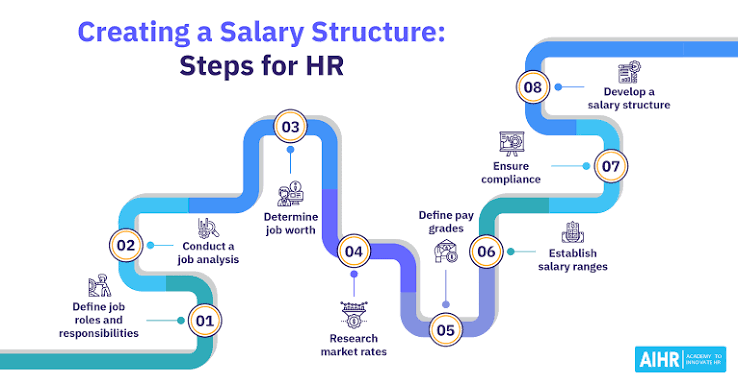
Developing a proper salary structure is one of the most important responsibilities of an HR team. It determines how employees are compensated based on their roles, responsibilities, experience, skills and contribution to the organisation.
For businesses, salary planning is not simply about deciding how much to pay an employee. It is about creating a structured compensation system that supports business growth, attracts the right talent and maintains fairness across different job levels.
A poorly designed salary structure can create employee dissatisfaction, salary inconsistencies and difficulties in retaining skilled professionals.
On the other hand, a well-planned salary structure helps businesses manage payroll efficiently while providing employees with a clear understanding of their earning potential.
So, how can businesses develop a salary structure for different job levels?
Let’s understand the process step by step.
1. Understand the Different Job Levels in Your Organisation
Before developing a salary structure, businesses need to identify the different positions and levels within the organisation.
Not every employee has the same responsibilities, decision-making authority or experience requirements. Therefore, salary levels should reflect the value and expectations associated with each role.
A typical organisational structure may include:
Job LevelTypical PositionsKey ResponsibilitiesEntry LevelTrainees, Interns, Junior ExecutivesBasic operational tasks and learningJunior LevelExecutives, CoordinatorsIndependent task executionMid-LevelSenior Executives, Team LeadersTeam coordination and specialised workManagerial LevelManagers, Department HeadsTeam management and operational planningSenior ManagementGeneral Managers, DirectorsStrategic decisions and business performance
The exact hierarchy depends on the size and nature of the organisation.
Clearly defining these levels creates a foundation for consistent salary decisions.
2. Conduct Job Evaluation
Job evaluation helps businesses understand the relative importance of different positions within the organisation.
Two employees may have similar experience but completely different responsibilities. Their compensation should therefore be evaluated based on the nature and value of their roles.
Some important factors to consider include:
Educational qualifications.
Relevant work experience.
Technical and professional skills.
Job responsibilities.
Decision-making authority.
Leadership requirements.
Business impact.
Level of accountability.
For example, a finance manager may have responsibilities involving budgeting, financial reporting and compliance, while a sales executive may focus on customer acquisition and revenue generation.
Their salary structures should reflect the requirements and responsibilities of their respective positions.
3. Research Industry Salary Benchmarks
One of the biggest mistakes businesses make is deciding salaries without understanding current market standards.
If salaries are significantly below market expectations, attracting and retaining skilled employees can become difficult.
At the same time, offering salaries beyond the company’s financial capacity can increase operational costs.
Businesses should conduct salary benchmarking before finalising compensation levels.
Useful sources include:
Industry salary reports.
Recruitment consultants.
Job portals.
Professional salary surveys.
Competitor job postings.
Industry networks and HR professionals.
When comparing salaries, consider location, industry, company size, experience and job responsibilities.
For example, salary expectations for a digital marketing executive in Kochi may differ from those for a similar position in Bengaluru or Mumbai.
The objective is to develop a competitive salary structure that also fits the organisation’s budget.
4. Define Salary Components
A salary structure should clearly explain how an employee’s total compensation is divided.
In India, salary structures commonly include fixed pay, allowances, employer contributions and variable components, depending on the organisation’s compensation policy and applicable legal requirements.
Some common components are:
Salary ComponentDescriptionBasic SalaryCore component of an employee’s salaryHouse Rent Allowance (HRA)Allowance towards accommodation expenses, where providedSpecial AllowanceAdditional salary componentConveyance AllowanceTransport-related allowance, where applicablePerformance IncentivesVariable compensation based on performanceEmployer PF ContributionEmployer contribution where applicableGratuityStatutory or contractual benefit, where applicable
Not every organisation needs to use all these components.
The structure should be designed according to the employee’s role, company policy, applicable tax provisions and statutory requirements.
5. Create Salary Bands for Different Job Levels
Salary bands help businesses maintain consistency when compensating employees within similar job categories.
Instead of assigning a completely different salary to every employee, organisations can establish a minimum, midpoint and maximum salary for each job level.
For example, the following is an illustrative salary band structure for a small or medium-sized business.
Job LevelMonthly Salary RangeEntry Level₹12,000 – ₹18,000Junior Level₹18,000 – ₹28,000Mid-Level₹28,000 – ₹45,000Managerial Level₹45,000 – ₹75,000Senior Management₹75,000 – ₹1,20,000+
These figures are examples for explaining salary bands, not recommended market rates or statutory minimum wages. Actual ranges should be determined through industry benchmarking, role evaluation and business affordability.
Salary bands give HR teams flexibility while reducing unexplained salary differences between employees performing comparable roles.
6. Consider Experience, Skills and Performance
Job level alone should not determine an employee’s salary.
Experience, specialised knowledge, individual performance and additional responsibilities can also influence compensation.
For example, two employees working as senior executives may have different salaries because one has more relevant experience or manages additional responsibilities.
Businesses should establish clear salary progression criteria.
Consider these factors:
Relevant professional experience.
Technical certifications.
Job-specific expertise.
Performance achievements.
Leadership capabilities.
Additional responsibilities.
Contribution to business objectives.
A transparent evaluation process helps employees understand how they can progress to higher compensation levels.
7. Maintain Internal Salary Equity
Internal salary equity means ensuring that employees performing comparable work are compensated fairly and consistently.
Unexplained salary differences can create dissatisfaction and affect workplace relationships.
For example, if two employees have similar experience, responsibilities and performance levels, a significant salary difference may create questions about fairness.
HR teams should periodically review compensation across departments and job levels.
Ways to maintain salary equity:
Develop standard salary bands.
Establish clear promotion criteria.
Document salary revision decisions.
Review compensation differences.
Apply consistent evaluation methods.
Consider equal remuneration and applicable anti-discrimination requirements.
A fair salary structure improves transparency and helps build employee trust.
8. Include Statutory Compliance in Salary Planning
Salary structure development must also consider applicable employment and tax regulations.
Businesses in India should review the relevant provisions governing wages, social security, minimum wages, tax deductions and other statutory obligations.
Some important areas include:
Minimum Wages: Ensure that employee compensation complies with the applicable minimum wage requirements based on the state, industry, employment category and relevant notifications.
Provident Fund (PF): Review employee eligibility, applicable wage definitions, contribution calculations and current EPF requirements.
Employee State Insurance (ESI): Identify eligible employees and calculate contributions according to applicable provisions.
Professional Tax: Consider state-specific professional tax requirements, where applicable.
Tax Deduction at Source (TDS): Calculate salary-related tax deductions based on applicable income tax provisions and employee declarations.
Gratuity: Account for applicable gratuity obligations when designing total compensation and employee benefit policies.
The four Labour Codes have also changed the statutory framework for wages and social security. Employers should ensure that their salary structures are aligned with the applicable provisions and current implementation rules.
A salary structure should never be designed only to reduce deductions or minimise statutory costs.
9. Develop a Clear Salary Revision and Promotion Policy
A salary structure should not remain unchanged as the organisation grows.
Employees gain experience, take on new responsibilities and contribute to business development. Their compensation should be reviewed through a transparent process.
Businesses should establish clear policies for:
Annual salary revisions.
Performance-based increments.
Promotions.
Role changes.
Internal transfers.
Additional responsibilities.
Exceptional salary adjustments.
For example, an employee moving from an executive position to a team leader role may receive a salary revision based on the additional responsibilities and the relevant salary band.
A structured revision policy helps businesses manage employee expectations and compensation budgets.
10. Use HRMS and Payroll Systems to Manage Salary Structures
Managing multiple salary structures manually can become difficult, especially when an organisation has several departments and job levels.
HRMS and payroll software can help businesses organise employee compensation and reduce administrative errors.
Useful features include:
Employee salary records.
Salary component management.
Payroll calculations.
Attendance integration.
Statutory deduction calculations.
Payslip generation.
Increment and revision records.
Payroll reports.
Businesses should choose a system that supports their workforce size, payroll requirements and applicable compliance processes.
Automation can improve accuracy, but salary structures and statutory calculations still need periodic human review.
Practical Salary Structure Development Checklist
Before implementing a salary structure, HR teams can use this checklist:
Identify all job roles and organisational levels.
Prepare clear job descriptions.
Conduct job evaluations.
Research industry salary benchmarks.
Define salary components.
Establish salary bands.
Review internal salary equity.
Check applicable statutory requirements.
Develop salary revision and promotion policies.
Document and communicate the final structure.
Review the structure periodically.
Final Thoughts
A well-designed salary structure is more than a payroll document. It is an important part of workforce planning and employee management.
By considering job responsibilities, industry benchmarks, employee experience, performance and statutory requirements, businesses can develop a compensation system that is fair, competitive and financially sustainable.
For growing businesses, having a structured salary system also makes recruitment, promotions, payroll administration and HR planning easier.
At Level Up HR Solutions, we help businesses organise their HR operations through HR documentation, payroll administration, statutory compliance support and ongoing HR assistance.
Our aim is to help businesses build structured HR processes that support both employee satisfaction and business growth.
Simplifying HR. Strengthening Businesses. Your Complete HR Partner.
For HR support, contact Level Up HR Solutions:
Phone: 8714805999
Email: info@leveluphrs.com
Website: www.leveluphrs.com
SEO Keywords
Primary Keyword: How to develop a salary structure
Secondary Keywords:
Salary structure for different job levels
Salary structure in India
Employee compensation planning
Salary components in India
Salary benchmarking for businesses
HR salary management
Payroll structure for employees
Salary bands and compensation management
HR salary planning