
23Sep

How Long Should Employers Keep Employee and HR Records?

by Naziha , Digital Marketing Executive

Employee records are an essential part of running a business. From the moment a candidate joins the organization until long after they leave, employers collect and manage a significant amount of information.

This may include employment contracts, payroll records, attendance details, tax documents, performance records, statutory compliance information, and exit documents.

However, an important question often creates confusion for employers and HR teams:

How long should employee and HR records actually be kept?

Keeping records for too short a period can create problems during an audit, inspection, tax assessment, employee dispute, or statutory inquiry. On the other hand, keeping personal information indefinitely can create unnecessary data management and privacy risks.

The right approach is to establish a structured HR records retention policy based on applicable labour laws, tax requirements, social security regulations, and legitimate business needs.

This guide explains the importance of HR record retention, the types of documents employers should maintain, and the key factors to consider when deciding how long records should be retained.


Why Is HR Record Retention Important?

Good record retention is not simply an administrative practice.

Employee and HR records can help organizations demonstrate compliance and protect themselves when questions arise.

Proper record retention can support businesses during:

  • Labour inspections

  • Statutory audits

  • Tax assessments

  • Employee disputes

  • Legal proceedings

  • PF and ESI reviews

  • Internal compliance audits

For example, if an employee disputes a salary payment made several years earlier, accurate payroll and attendance records can help the employer verify what actually happened.

Without proper records, even a correctly managed process may become difficult to prove.


What Types of Employee and HR Records Should Employers Keep?

HR records are created throughout the employee lifecycle.

A useful way to organize them is from hiring to exit.


1. Recruitment and Pre-Employment Records

Before an employee joins, employers may collect documents relating to the recruitment process.

These may include:

  • Job applications

  • Resumes or CVs

  • Interview records

  • Background verification documents

  • Reference check information

  • Employment eligibility documents

  • Educational qualification records

Not every document needs to be retained forever.

Employers should determine which records are required for compliance, potential disputes, or legitimate business purposes.

Candidate information should also be handled carefully, especially when a candidate is not ultimately hired.


2. Employment and Joining Documents

Once an employee joins, organizations generally create important employment records.

These may include:

  • Offer letter

  • Appointment letter

  • Employment agreement

  • Employee information form

  • Identity documents

  • Address details

  • Policy acknowledgements

  • Bank details

  • Emergency contact information

These documents help establish the employment relationship and should be securely maintained.


3. Payroll and Salary Records

Payroll records are among the most important documents employers need to retain.

They may include:

  • Salary registers

  • Payslips

  • Wage calculations

  • Attendance records

  • Overtime records

  • Bonus and incentive records

  • Salary revision documents

  • Payment records

Payroll documentation may be required for labour law compliance, tax purposes, statutory audits, and employee claims.


4. PF and ESI Records

Organizations covered by applicable social security requirements may need to maintain records relating to:

  • Employee registration

  • PF contributions

  • ESI contributions

  • Wage information

  • Monthly returns and filings

  • Contribution payment records

These records can become important during inspections, assessments, or compliance reviews.

HR and payroll teams should ensure that digital records are organized and easily retrievable.


5. Tax and TDS Records

Employers should also maintain records relating to employee tax processing.

These may include:

  • Employee tax declarations

  • Investment declarations

  • TDS calculations

  • Salary and income details

  • Form 16 information

  • Supporting tax-related records

The applicable tax laws may prescribe specific retention periods, so employers should avoid destroying these records simply because an employee has left the organization.


6. Attendance and Leave Records

Attendance records can be important for:

  • Payroll calculations

  • Leave management

  • Overtime verification

  • Employee disputes

  • Labour inspections

Records may include:

  • Daily attendance

  • Leave applications

  • Leave approvals

  • Absence records

  • Shift schedules

  • Work-from-home approvals, where applicable

These records should be retained according to the applicable requirements and organizational policy.


7. Performance and Training Records

HR departments may also maintain:

  • Performance reviews

  • Appraisal records

  • Training records

  • Development plans

  • Promotion documentation

  • Skill certifications

These documents can support employee development and help organizations maintain a history of employment-related decisions.

However, performance-related information should be handled confidentially.


8. Disciplinary and Grievance Records

Organizations should maintain appropriate records relating to:

  • Employee complaints

  • Grievances

  • Workplace investigations

  • Warning letters

  • Disciplinary action

  • Corrective measures

These records can be important if a workplace dispute develops later.

Access should be restricted because these documents often contain sensitive personal information.


9. Employee Exit Records

When an employee leaves the organization, HR should not simply delete their information immediately.

Important exit records may include:

  • Resignation letter

  • Resignation acceptance

  • Notice period records

  • Full and final settlement

  • Asset return documents

  • Exit interview records

  • Relieving letter

  • Experience certificate

  • System access revocation confirmation

These records can help resolve future questions relating to the employee’s employment and separation.


So, How Long Should HR Records Be Kept?

There is no single retention period that applies to every HR document.

The correct period depends on:

  • Applicable labour laws

  • Tax regulations

  • Social security requirements

  • Industry regulations

  • Contractual obligations

  • Limitation periods for potential claims

  • The organization’s legitimate business needs

For this reason, organizations should avoid using a single rule such as:

“Keep every employee document for five years.”

Different documents may be governed by different requirements.


A Practical HR Records Retention Framework

Instead of applying one retention period to everything, employers can create categories.

Recruitment Records

Keep for the period required to address recruitment-related legal or business requirements.


Employment Records

Retain throughout employment and for an appropriate period after separation.


Payroll Records

Retain according to applicable wage, tax, and accounting requirements.


Statutory Records

Follow the specific retention period required under the relevant law.


Tax Records

Follow applicable income tax and financial record retention requirements.


Employee Dispute Records

Retain until relevant disputes, investigations, or legal proceedings are resolved and any required retention period has passed.

This structured approach is more effective than applying one general timeline to all records.


Why Keeping Everything Forever Is Not the Best Solution

Some employers believe the safest option is to keep every document permanently.

However, indefinite retention can create risks.

The more personal information an organization stores, the greater the potential impact of:

  • Data breaches

  • Unauthorized access

  • Information misuse

  • Storage costs

  • Outdated information

A good retention policy should balance compliance requirements with data minimization and security.

Once a document is no longer required, organizations should consider secure deletion or destruction according to their retention policy and applicable requirements.


How to Create an HR Records Retention Policy

Every organization should have a clear HR records retention policy.

The policy should identify:

1. What documents are collected

Create categories for employee and HR records.


2. Why they are collected

Identify the legal, operational, or legitimate business purpose.


3. How long they should be retained

Specify the retention period based on applicable requirements.


4. Who can access them

Restrict access to authorized personnel.


5. Where documents are stored

Maintain a secure and organized storage system.


6. How documents are destroyed

Define a secure deletion or destruction process.


Digital Records Need a Retention Policy Too

Many organizations have moved from physical files to digital HR systems.

However, digitization does not remove retention responsibilities.

Employers should ensure that digital records are:

  • Properly organized

  • Securely stored

  • Protected from unauthorized access

  • Backed up appropriately

  • Easy to retrieve

  • Deleted securely when no longer required

A document stored in an employee’s personal email inbox is not an effective HR record management system.

Centralized HR platforms can help improve organization and access control.


Common HR Record Retention Mistakes

1. Having No Written Retention Policy

Without a policy, employees may store or delete documents inconsistently.


2. Applying the Same Retention Period to Every Record

Different documents may be subject to different requirements.


3. Deleting Records Immediately After an Employee Leaves

Former employees may still raise questions or claims after separation.


4. Keeping Sensitive Data Without a Purpose

Unnecessary data creates additional privacy and security risks.


5. Storing Records Across Multiple Unsecured Locations

Documents should not be scattered across personal computers, emails, messaging apps, and unprotected folders.


6. Forgetting About Digital Backups

Deleting a file from one system does not necessarily remove copies stored in backups.

Organizations should consider backup retention procedures as part of their overall policy.


A Simple HR Records Retention Checklist

Before deleting any employee or HR document, ask:

✔ Is there a legal requirement to retain this document?

✔ Is the document required for tax or statutory compliance?

✔ Could the document be relevant to an ongoing dispute or investigation?

✔ Has the applicable retention period expired?

✔ Is there a legitimate business reason to keep it?

✔ Does the document contain sensitive personal information?

✔ Is the document being securely deleted or destroyed?

This simple checklist can prevent accidental destruction of important records.


How HR Technology Can Help

Modern HR and document management systems can make record retention easier.

These systems may help organizations:

  • Centralize employee files

  • Control access permissions

  • Track document history

  • Set retention reminders

  • Maintain audit trails

  • Identify documents due for deletion

  • Reduce dependence on physical paperwork

However, technology should support a well-designed retention policy.

The organization must first determine what to retain, why to retain it, and for how long.


Final Thoughts

Employee and HR record retention is an important part of compliance, risk management, and good HR governance.

There is no universal answer to the question of how long every document should be kept. The appropriate retention period depends on the type of record and the laws and regulations applicable to the organization.

The best approach is to create a structured retention policy covering the entire employee lifecycle—from recruitment and hiring to employment, payroll, statutory compliance, and exit.

A strong HR records retention process helps organizations:

  • Stay prepared for audits and inspections

  • Support accurate payroll and statutory compliance

  • Manage employee disputes

  • Protect sensitive information

  • Reduce unnecessary data storage

In 2026, effective HR record management is not simply about keeping documents for as long as possible.

It is about keeping the right records, for the right reasons, for the right amount of time—and protecting them throughout their lifecycle.

22Sep

Work From Home Policy: What Should Employers Clearly Define?

By Afla KC , Digital Marketing Executive

Introduction

Work from home has become an important part of modern workplace management. For many organisations, remote work is no longer simply a temporary arrangement. It has become a practical way to offer flexibility, attract talent, improve employee satisfaction, and maintain business continuity.

However, allowing employees to work fro

m home without clear guidelines can create challenges.

Questions can quickly arise:

  • When can employees work from

  •  home?

  • Who is eligible?

  • What are the expected working hours?

  • How should attendance be recorded?

  • How should employees

  • communicate with their teams?

  • Who provides laptops and other equipment?

  • How is employee performance measured?

  • What happens if an em

  • ployee is unavailable during working hours?

A well-designed Work From Home (WFH) Policy provides clarity for both employers and employees. It establishes expectations while giving employees the flexibility to work effectively outside the traditional office environment.

A good policy should not simply say that employees are “allowed to work from home.” It should clearly explain how remote work will operate in practice.

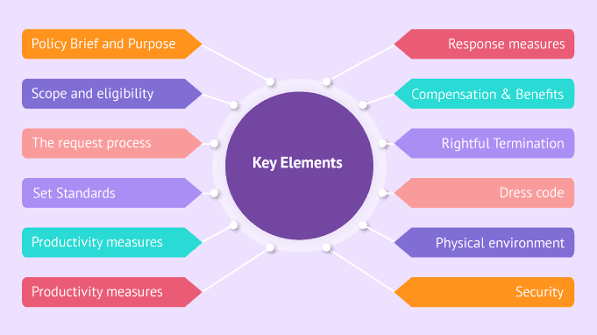
This guide covers the key areas employers should define when creating a work-from-home policy.


What Is a Work From Home Policy?

A Work From Home Policy is a formal company guideline that explains when and how employees may perform their duties remotely.

It establishes expectations around:

  • Eligibility

  • Working hours

  • Attendance

  • Communication

  • Productivity

  • Performance

  • Technology

  • Data security

  • Expenses

  • Leave

  • Availability

  • Health and safety

  • Policy violations

The purpose is to create a structured remote-working environment rather than leaving expectations open to interpretation.


1. Clearly Define Who Is Eligible

Not every role can necessarily be performed remotely.

Employers should clearly identify which employees or job roles are eligible for work from home.

Eligibility may depend on:

  • Nature of the job

  • Department

  • Employee responsibilities

  • Business requirements

  • Performance

  • Seniority, where applicable

  • Availability of necessary technology

For example, a software developer may be able to work remotely, while a production-floor employee may need to be physically present.

The policy should explain whether WFH is:

  • Available to all eligible employees

  • Available only to selected roles

  • Subject to manager approval

  • Available only in specific circumstances

Clear eligibility criteria can prevent confusion and perceptions of unfair treatment.


2. Define When Work From Home Is Allowed

Employers should specify whether remote work is:

Fully Remote

Employees work from home on a permanent basis.

Hybrid

Employees divide their working time between the office and home.

Occasional WFH

Employees can request remote work for specific days or situations.

Emergency WFH

Employees may work remotely during exceptional circumstances such as severe weather, transportation disruptions, or other emergencies.

The policy should clearly explain which model the organisation follows.


3. Establish Working Hours

Remote work does not mean that working hours become undefined.

Employers should clearly mention:

  • Standard working hours

  • Start and end times

  • Lunch or break periods

  • Core availability hours

  • Shift timings, where applicable

  • Overtime requirements

  • Time-zone expectations for distributed teams

For example, a company may require employees to be available between specific core hours while allowing some flexibility around their start and finish times.

The important point is to create clarity without unnecessarily micromanaging employees.


4. Define Attendance Requirements

Attendance tracking should be clearly addressed.

Employees should know:

  • How attendance is marked

  • Whether login/logout is required

  • How breaks are recorded

  • What happens if there is a technical issue

  • How late attendance is handled

  • How WFH days are recorded

If the organisation uses HRMS or attendance software, the policy should explain the expected process.

A consistent attendance system can also help payroll teams maintain accurate salary and leave records.


5. Explain the WFH Approval Process

Employees should know how to request work from home.

The policy may specify:

  • Who approves WFH

  • How many days can be requested

  • How much advance notice is required

  • Emergency request procedures

  • Documentation requirements, where applicable

For example:

Employee → Reporting Manager → HR, where required

A clearly defined approval workflow prevents informal arrangements from creating administrative problems.


6. Set Communication Expectations

Communication is one of the biggest challenges in remote work.

Employees should know which communication channels are used for different purposes.

For example:

  • Email for formal communication

  • Instant messaging for quick updates

  • Video calls for meetings

  • Project management tools for task tracking

  • HRMS for attendance and leave

The policy can also establish expectations around response times.

For example, employees may be expected to respond to work-related communication during agreed working hours.


7. Define Meeting and Collaboration Rules

Remote employees need to remain connected with their teams.

Employers can establish guidelines around:

  • Online meetings

  • Team calls

  • Camera usage

  • Meeting punctuality

  • Calendar availability

  • Meeting etiquette

  • Internal collaboration

However, organisations should avoid unnecessary meetings.

Remote work is more effective when employees have enough uninterrupted time to complete their actual responsibilities.


8. Set Clear Performance Expectations

One of the biggest misconceptions about remote work is that productivity should be measured by how long an employee appears online.

Instead, organisations should focus on:

  • Deliverables

  • Deadlines

  • Quality of work

  • Goals

  • Customer outcomes

  • Team contribution

Managers should establish measurable performance expectations.

This helps employees understand what they are accountable for while giving them reasonable flexibility in how they complete their work.


9. Define Technology and Equipment Responsibilities

Employers should clearly state who provides the equipment required for remote work.

This may include:

  • Laptop

  • Monitor

  • Keyboard and mouse

  • Headset

  • Internet connection

  • Required software

  • Security tools

The policy should clarify:

  • Who owns company equipment

  • How equipment is maintained

  • What happens if equipment is damaged

  • Whether employees can use personal devices

  • What happens when employment ends

Clear equipment guidelines can prevent disputes later.


10. Address Data Security and Confidentiality

Remote employees may access sensitive company information outside the office.

Therefore, data security should be a major part of any WFH policy.

Employees should be instructed to:

  • Use approved devices

  • Protect passwords

  • Avoid sharing company credentials

  • Use authorised software

  • Secure confidential documents

  • Avoid accessing sensitive information through unsafe networks

  • Report suspected security incidents

Where applicable, organisations should also use tools such as multi-factor authentication, device management, VPNs, and access controls.

The policy should make it clear that company data remains confidential regardless of where the employee works.


11. Explain Internet and Other Work Expenses

Employers should clarify whether they provide or reimburse expenses related to remote work.

Possible expenses include:

  • Internet

  • Mobile communication

  • Electricity

  • Equipment

  • Software subscriptions

  • Other approved work-related costs

If reimbursement is available, the policy should specify:

  • Eligible expenses

  • Maximum limits

  • Required documents

  • Approval process

  • Reimbursement timelines

Avoid vague statements such as “reasonable expenses will be reimbursed” without defining what reasonable means.


12. Include Leave and Absence Rules

Employees working remotely should follow the same applicable leave procedures unless the organisation specifically provides otherwise.

The policy should explain:

  • How leave is requested

  • Who approves leave

  • How emergency leave is communicated

  • How sick leave is reported

  • What happens when an employee becomes unavailable during working hours

Working from home should not be treated as a substitute for applying for leave when an employee is unable to work.


13. Define Health and Safety Expectations

Employers should encourage employees to maintain a safe and suitable home-working environment.

Employees can be advised to:

  • Use an appropriate workstation

  • Maintain good posture

  • Take regular breaks

  • Avoid unsafe work setups

  • Report work-related incidents where required

Depending on the organisation and applicable legal requirements, employers may also consider providing ergonomic guidance or support.


14. Define Geographic Restrictions

Employers should clarify whether employees can work from any location or only from an approved residence.

This is particularly important when employees want to work:

  • From another city

  • From another state

  • From another country

Working from another location can potentially affect taxation, employment compliance, data security, insurance, and other business considerations.

Therefore, employees should obtain approval before changing their regular remote-working location where the policy requires it.


15. Address Employee Privacy

Remote work can create concerns about employee monitoring.

If an organisation uses monitoring software, attendance tracking, device management, or other technology, employees should be informed about:

  • What is monitored

  • Why it is monitored

  • How information is used

  • Who can access it

  • How long relevant information is retained

Employers should aim for transparency and ensure that monitoring practices are consistent with applicable laws and company policies.


16. Define Policy Violations

Employees should understand what happens when WFH rules are repeatedly violated.

Examples may include:

  • Unauthorised absence

  • Misuse of company equipment

  • Sharing confidential information

  • Repeated failure to attend required meetings

  • Misrepresentation of attendance

  • Failure to meet agreed responsibilities

The policy should explain that violations may result in appropriate action under the organisation’s disciplinary procedures.


17. Include Business Continuity Provisions

Remote work policies can also support business continuity.

Employers should explain what happens when:

  • The office becomes unavailable

  • There is a local emergency

  • Employees cannot travel

  • Critical systems are disrupted

  • Certain teams need to operate remotely

Having a predefined process allows organisations to respond faster during unexpected situations.


18. Review the Policy Regularly

A WFH policy should not be treated as a document that is created once and forgotten.

Businesses should review it periodically based on:

  • Changes in workforce structure

  • Technology

  • Employee feedback

  • Business requirements

  • Changes in applicable laws

  • Security requirements

HR teams can also use employee feedback to identify areas where the policy needs improvement.


Common Work From Home Policy Mistakes

Employers should avoid:

Being Too Vague

Statements such as “employees can work remotely when required” create confusion.

Treating Every Role the Same

Different roles may have different operational requirements.

Focusing Only on Attendance

Productivity should not be measured purely by online presence.

Ignoring Data Security

Remote access increases the importance of cybersecurity controls.

Failing to Define Equipment Responsibility

Employees and employers may have different expectations about who pays for equipment and expenses.

Not Defining Approval Procedures

Informal WFH arrangements can create attendance and payroll problems.

Not Communicating the Policy

Even the best policy is ineffective if employees do not understand it.


A Simple Work From Home Policy Checklist

Before implementing a WFH policy, HR teams should confirm that it addresses:

✓ Eligibility

✓ Remote work model

✓ Working hours

✓ Attendance

✓ WFH approval process

✓ Communication

✓ Meetings

✓ Performance expectations

✓ Equipment

✓ Internet and expenses

✓ Data security

✓ Confidentiality

✓ Leave and absence

✓ Health and safety

✓ Geographic restrictions

✓ Employee privacy

✓ Policy violations

✓ Business continuity

✓ Policy review


Conclusion

A successful Work From Home policy is not simply about giving employees permission to work outside the office. It is about creating a clear framework that balances flexibility with accountability.

Employees should understand when they can work remotely, what is expected from them, how they should communicate, how performance will be evaluated, and what responsibilities they have while working from home.

Employers, meanwhile, need clarity around attendance, productivity, equipment, expenses, data security, employee privacy, and compliance.

The most effective WFH policies are clear, practical, flexible, and aligned with the organisation’s actual working environment. They should provide enough structure to maintain productivity and accountability without creating unnecessary restrictions.

As businesses continue to adopt hybrid and remote working models, HR teams should regularly review their policies and ensure that they reflect current business needs and applicable legal requirements.

Ultimately, a well-designed Work From Home policy benefits both sides. Employees gain clarity and flexibility, while employers gain a more structured approach to managing remote teams.

A good WFH policy doesn’t just define where employees work—it defines how people can work effectively, responsibly, and consistently.

21Sep

HR Audit Evidence: What Records and Proof Should Companies Keep Ready?

By Nandana G.S , Digital Marketing Executive

An HR audit is not only about checking whether policies and processes exist. It is also about verifying whether the organization can prove that those processes are being followed.

For businesses, maintaining proper HR records helps demonstrate compliance, identify gaps, support payroll accuracy, and stay prepared for internal reviews, statutory inspections, or employee-related disputes.

What Is HR Audit Evidence?

HR audit evidence refers to the documents, records, reports, approvals, registers, and other supporting proof that demonstrate how an organization’s HR processes are being managed.

Having a policy on paper is one thing. Being able to show evidence of its implementation is another.

1. Employee Personal and Employment Records

HR should maintain accurate records for every employee, including:

✔️ Employee application/resume ✔️ Offer or appointment letter ✔️ Joining documentation ✔️ Employment agreement, where applicable ✔️ Employee master data ✔️ Designation and department records ✔️ Salary and compensation details ✔️ Promotion or transfer records ✔️ Relevant employee declarations and forms

These records should be organized and updated whenever employee information changes.

2. Attendance and Leave Records

Attendance and leave documentation is important for both HR administration and payroll verification.

Companies should maintain:

  • Attendance records

  • Leave applications and approvals

  • Leave balances

  • Late-coming or absence records, where applicable

  • Overtime records, where applicable

  • Working-hours records

The records should be consistent with the information used for payroll processing.

3. Payroll and Salary Records

Payroll is one of the key areas reviewed during an HR audit.

Evidence may include:

✔️ Salary registers ✔️ Payroll processing reports ✔️ Payslips ✔️ Salary structure records ✔️ Deductions and recoveries ✔️ Overtime or incentive calculations ✔️ Full & Final settlement records ✔️ Payroll reconciliation reports

HR and payroll teams should be able to explain significant variations or adjustments.

4. Statutory Compliance Records

Companies should maintain appropriate evidence relating to applicable statutory requirements.

Depending on the organization’s applicability, this may include records relating to:

  • PF

  • ESI

  • Professional Tax

  • TDS

  • Labour Welfare Fund

  • Gratuity

  • Applicable labour-law registers and returns

  • Statutory payments and acknowledgements

The exact records required can vary based on the organization’s location, workforce, and applicable laws.

5. HR Policies and Employee Acknowledgements

Having policies is not enough. Organizations should also maintain evidence that employees have been informed about relevant policies.

Examples include:

✔️ Employee handbook ✔️ Leave policy ✔️ Attendance policy ✔️ Code of conduct ✔️ POSH policy ✔️ Work-from-home policy ✔️ Disciplinary policy ✔️ Policy acknowledgement records

Whenever policies are updated, HR should maintain appropriate communication and acknowledgement records.

6. Recruitment and Onboarding Records

An HR audit may also examine whether recruitment and onboarding processes are properly documented.

Keep records such as:

  • Job descriptions

  • Interview evaluation forms

  • Selection approvals

  • Offer letters

  • Joining checklists

  • Onboarding documentation

  • Employee induction records

  • Background verification records, where applicable

A standardized recruitment file can make the audit process much easier.

7. Performance Management Records

Performance-related decisions should have supporting documentation.

HR may maintain:

✔️ Performance appraisal records ✔️ Goal-setting documents ✔️ Performance review forms ✔️ Feedback records ✔️ Performance improvement plans ✔️ Promotion recommendations ✔️ Increment approvals

Proper documentation can help demonstrate that employment decisions were based on an established process.

8. Training and Development Records

Organizations should maintain evidence of employee development activities.

This can include:

  • Training calendars

  • Attendance records

  • Training completion certificates

  • Skill development records

  • Training feedback

  • POSH awareness/training records

  • Other mandatory or role-specific training records

9. Disciplinary and Grievance Records

Where disciplinary or grievance matters arise, HR should maintain appropriate documentation.

Depending on the situation, this may include:

  • Employee complaints

  • Written explanations

  • Show-cause notices

  • Warnings

  • Investigation records

  • Management decisions

  • Grievance resolution records

These records should be handled with appropriate confidentiality and access controls.

10. Employee Exit Documentation

The employee exit process should also have a complete documentation trail.

HR should maintain:

✔️ Resignation letter/email ✔️ Resignation acceptance ✔️ Notice-period records ✔️ Handover documentation ✔️ Clearance records ✔️ Asset-return confirmation ✔️ Exit interview, where conducted ✔️ Full & Final settlement ✔️ Relieving and experience documents

A properly documented exit process can help reduce misunderstandings after separation.

11. HR Audit Trail and Approvals

One commonly overlooked area is proof of approvals and decision-making.

Organizations should retain appropriate evidence such as:

  • Management approvals

  • Salary revision approvals

  • Leave approvals

  • Hiring approvals

  • Policy approvals

  • Exception approvals

  • HR communications

  • Relevant email trails

This helps auditors understand not just what happened, but who authorized it and when.

12. Digital Records and Access Control

Modern HR departments increasingly rely on digital HRMS and payroll systems.

Companies should ensure that digital records are:

✔️ Properly organized ✔️ Backed up ✔️ Accessible to authorized personnel ✔️ Protected from unauthorized access ✔️ Retained according to applicable requirements

Important documents should not exist only in individual employees’ personal email accounts or local computer folders.

Common HR Audit Evidence Gaps

Businesses often face problems because they:

❌ Have policies but no acknowledgement records ❌ Maintain incomplete employee files ❌ Have payroll records that don’t match HR records ❌ Cannot produce approval trails ❌ Maintain inconsistent attendance and leave data ❌ Miss statutory payment or filing evidence ❌ Store documents across disconnected systems ❌ Fail to maintain proper exit documentation

HR Audit Evidence Checklist

A simple audit-ready HR file structure can include:

Employee Records → Recruitment → Onboarding → Attendance & Leave → Payroll → Statutory Compliance → Policies → Performance → Training → Grievances → Disciplinary Records → Exit Documentation → Approvals & Audit Trail

The goal is not to create paperwork for the sake of paperwork. The goal is to ensure that every important HR process has reliable supporting evidence.

How Level Up HR Solutions Can Help

At Level Up HR Solutions, we help businesses strengthen their HR systems through HR audits, HR documentation, payroll compliance, statutory compliance reviews, employee record management, and policy support.

An HR audit can help identify documentation gaps before they become larger compliance or operational problems.

Final Thoughts

Being audit-ready means more than having a collection of HR documents. Companies need a structured system where records are accurate, updated, traceable, and easy to retrieve.

When HR teams maintain proper evidence throughout the employee lifecycle, they can improve compliance, strengthen internal controls, and respond more confidently to audits and inspections.

Start building your HR audit file before you need it—not when an audit arrives.

Level Up HR Solutions 📞 +91 8714805999 📧 info@leveluphrs.com 🌐 www.leveluphrs.com

#HRAudit #HRAuditChecklist #HRCompliance #HRDocumentation #PayrollCompliance #StatutoryCompliance #EmployeeRecords #HRManagement #HRIndia #AuditReady #KeralaBusiness #KochiBusiness #LevelUpHRSolutions

18Sep

Old vs New Tax Regime: What Employers Need to Consider While Processing Payroll

by Naziha , Digital Marketing Executive

Processing employee salaries is not just about calculating gross pay and transferring the final amount to an employee’s bank account. One of the most important responsibilities for employers and payroll teams is calculating and deducting the correct amount of Tax Deducted at Source (TDS).

With employees having a choice between the old and new tax regimes, payroll processing has become more complex. HR and payroll teams must understand the employee’s tax regime, consider eligible deductions and exemptions, calculate projected annual taxable income, and ensure that monthly TDS is deducted correctly.

A wrong tax calculation can create problems for both the employer and the employee. Employees may face unexpected tax deductions or refunds, while employers may face payroll corrections and compliance issues.

For the 2026–27 tax year, payroll teams also need to ensure that their systems and processes reflect the applicable tax rules for the relevant period.

This guide explains the key differences between the old and new tax regimes and what employers should consider while processing employee payroll.


Understanding the Old and New Tax Regimes

India currently provides different tax structures for eligible individual taxpayers.

The new tax regime is the default regime, while eligible taxpayers can choose to opt for the old regime. The two regimes differ mainly in their tax rates and the availability of deductions and exemptions.

The old regime generally provides access to a wider range of deductions and exemptions, while the new regime generally offers different tax slabs and allows only limited deductions and exemptions.

For employers, this means payroll processing cannot follow a one-size-fits-all approach.


What Is the Old Tax Regime?

The old tax regime follows the traditional tax structure.

Under this regime, employees may be able to claim various eligible tax deductions and exemptions, subject to applicable conditions and limits.

Common examples may include:

  • House Rent Allowance (HRA), subject to applicable conditions

  • Leave Travel Allowance (LTA), where eligible

  • Certain deductions relating to investments

  • Eligible insurance-related deductions

  • Eligible deductions for specified expenses

  • Home loan-related tax benefits, where applicable

Because more deductions and exemptions may be available, the old regime can be beneficial for some employees who have significant eligible tax-saving investments or exemptions.

However, payroll teams must collect and verify the required declarations and supporting documents where necessary.


What Is the New Tax Regime?

The new tax regime is the default tax regime for eligible taxpayers.

It generally provides a different tax slab structure while allowing fewer deductions and exemptions compared with the old regime.

Under the official slab information available for AY 2026–27, the new regime for most individual taxpayers uses the following slab structure:

Taxable IncomeTax RateUp to ₹4 lakhNil₹4 lakh – ₹8 lakh5%₹8 lakh – ₹12 lakh10%₹12 lakh – ₹16 lakh15%₹16 lakh – ₹20 lakh20%₹20 lakh – ₹24 lakh25%Above ₹24 lakh30%

These rates are subject to applicable provisions, rebate rules, surcharge, and Health and Education Cess.

The lower or differently structured tax rates may benefit employees who do not have substantial deductions or exemptions available under the old regime.


Old Tax Regime vs New Tax Regime: A Quick Comparison

FactorOld Tax RegimeNew Tax RegimeDefault regimeNoYesTax slabsTraditional slab structureRevised slab structureDeductionsMore deductions may be availableLimited deductionsExemptionsSeveral exemptions may be availableMany exemptions are restrictedInvestment declarationsOften important for tax calculationDepends on eligible deductionsBest optionDepends on employee’s deductions and exemptionsDepends on employee’s income and tax position

There is no single regime that is automatically best for every employee.

The better option depends on factors such as:

  • Annual income

  • Eligible deductions

  • Eligible exemptions

  • Investments

  • Salary structure

  • Other taxable income

The Income Tax Department itself advises taxpayers to compare the tax liability under both regimes before making a decision.


1. Collect the Employee’s Tax Regime Intimation

One of the first things employers should do is obtain the employee’s intended tax regime for payroll purposes.

According to Income Tax Department guidance, an employee should intimate the employer regarding their intended tax regime during the year. If the employee does not provide an intimation, the employer generally treats the employee under the default new tax regime for TDS purposes.

Best practice for employers

At the beginning of the financial year, provide employees with a clear process to:

  • Select their intended tax regime for payroll purposes

  • Submit required declarations

  • Provide relevant information for TDS calculations

This helps payroll teams avoid incorrect assumptions.


2. Do Not Treat Every Employee the Same

A common payroll mistake is assuming that all employees should be processed under the same tax regime.

Employees have different financial situations.

For example:

Employee A

May have:

  • Significant eligible investments

  • Eligible HRA exemptions

  • Other applicable deductions

The old regime may potentially be more favourable.

Employee B

May have:

  • Few tax-saving investments

  • Limited exemptions

  • A relatively simple salary structure

The new regime may potentially result in a better tax outcome.

Employers should not recommend a regime without considering the individual’s circumstances. Their primary responsibility is to process payroll correctly based on the applicable rules and employee declarations.


3. Understand the Impact on Investment Proof Collection

The old and new regimes can significantly affect how HR teams collect investment declarations and proofs.

Under the old tax regime, employee declarations and eligible supporting documents may be important for calculating deductions and exemptions.

Payroll teams may need to process information relating to eligible:

  • Investments

  • Insurance payments

  • Rent details

  • Other deductions

  • Applicable exemptions

Under the new regime, many traditional deductions and exemptions are not available, although certain specified benefits may still be permitted under applicable tax provisions.

This can reduce the number of investment proofs required for some employees.

However, employers should not assume that no declarations are ever required under the new regime. The payroll team must consider deductions or exemptions that remain available under the applicable rules.


4. Calculate TDS Based on Projected Annual Income

Salary TDS should not simply be calculated by applying a tax percentage to one month’s salary.

Employers generally need to estimate the employee’s projected taxable income for the relevant tax year.

The calculation may include:

  • Monthly salary

  • Bonus payments

  • Incentives

  • Arrears

  • Other taxable benefits

  • Eligible exemptions

  • Applicable deductions

Once projected taxable income is determined, the employer can calculate the estimated annual tax liability and distribute the TDS appropriately across the remaining payroll months.

This is particularly important when an employee receives:

  • A salary increment

  • A bonus

  • A promotion

  • Variable pay

  • Additional taxable benefits


5. Update TDS When Salary Changes

Employee tax calculations should not remain unchanged throughout the year if the employee’s income changes.

For example, an employee may receive:

  • A salary increase

  • Annual bonus

  • Performance incentive

  • Sales commission

  • Arrears

These changes can increase projected annual income and affect the employee’s tax liability.

Payroll teams should review TDS calculations periodically rather than waiting until the end of the financial year.


6. Handle New Joiners Carefully

When a new employee joins an organization during the financial year, their current employer may need information about salary received from previous employment.

Without considering previous salary income, the employer may calculate TDS only on the salary paid by the current organization, potentially resulting in incorrect overall tax deductions.

HR and payroll teams should have a structured process for collecting relevant previous employment and salary information where required for accurate TDS processing.


7. Keep Accurate Employee Declarations and Records

Payroll compliance depends heavily on documentation.

Employers should maintain appropriate records relating to:

  • Employee tax regime intimation

  • Salary declarations

  • Investment declarations

  • Supporting documents, where applicable

  • Previous employment income information

  • Tax calculations

  • TDS deductions

Proper documentation can help organizations explain and support payroll calculations if questions arise later.


8. Understand That the New Regime Is the Default for Payroll Purposes

The new tax regime is the default regime under the applicable framework.

If an employee does not intimate their intended choice to the employer for the relevant year, the employer generally deducts TDS based on the default new tax regime.

This makes employee communication extremely important.

A simple annual email or HR portal declaration can help reduce confusion.


9. Employees May Have Different Options at the Return Stage

Employers should understand the difference between:

  • TDS processing during the year, and

  • The employee’s final tax position when filing their income tax return

For eligible individuals without business or professional income, the option relating to the tax regime may generally be exercised according to the applicable rules when filing the income tax return.

The employer’s payroll calculation is based on the information and regime intimation provided for TDS purposes during the year.

This is why employees should understand that payroll TDS and final tax return filing are related but should not always be treated as identical processes.


10. Update Payroll Systems for Current Tax Rules

Tax rules and administrative provisions can change.

For 2026–27, the Income Tax Department has specifically advised employers to reset TDS computation from 1 April 2026 for the new tax year, considering projected income, deductions, and the applicable tax regime. Payroll systems also need to reflect the relevant legislative and section-numbering changes applicable to the new tax year.

Payroll teams should ensure that:

  • Tax slabs are updated

  • TDS formulas are reviewed

  • The correct tax year is selected

  • Regime options are configured properly

  • Payroll software reflects current requirements

Using outdated payroll settings can result in incorrect deductions for every employee.


Common Payroll Mistakes Employers Should Avoid

1. Automatically Applying the Same Regime to Everyone

Employees may have different tax situations.

Always obtain the required regime intimation and process TDS accordingly.


2. Using Outdated Tax Slabs

Tax slabs can change from one tax year to another.

Payroll software should be reviewed at the beginning of every financial year.


3. Ignoring Employee Investment Declarations

For employees using the old regime, eligible declarations and supporting information can significantly affect taxable income.


4. Forgetting Salary Revisions

A salary increment or bonus can change projected annual tax liability.

TDS should be recalculated when necessary.


5. Not Considering Previous Employment Income

New employees may already have received taxable salary from another employer during the same year.


6. Waiting Until the Last Month to Correct TDS

Waiting until the end of the year can result in a large and unexpected TDS deduction from the employee’s final salaries.

Periodic reviews are much better.


A Simple Payroll Checklist for HR Teams

Before finalizing payroll, HR and payroll teams should check:

✔ Has the employee provided their tax regime intimation?

✔ Is the default regime being applied correctly where no intimation has been provided?

✔ Are the current tax slabs configured correctly?

✔ Has projected annual income been calculated?

✔ Have salary increments and bonuses been considered?

✔ Are applicable deductions and exemptions processed correctly?

✔ Have required declarations and documents been collected?

✔ Has previous employment income been considered where necessary?

✔ Has monthly TDS been reviewed and adjusted?

✔ Are payroll records securely maintained?


How Technology Can Simplify Tax Regime Management

Modern payroll systems can help employers manage tax compliance by:

  • Allowing employees to select a tax regime

  • Collecting declarations digitally

  • Tracking investment submissions

  • Calculating projected tax liability

  • Automatically adjusting TDS

  • Generating payroll reports

  • Maintaining employee records

However, automation should always be supported by regular payroll reviews.

Incorrect system configuration can automate errors just as efficiently as it automates correct calculations.


Final Thoughts

The choice between the old and new tax regimes has made payroll processing more important than simply calculating monthly salary.

Employers need a structured process to collect employee tax regime information, calculate projected annual income, process eligible deductions and exemptions, and review TDS regularly throughout the year.

The new tax regime is the default, but the most suitable regime can vary depending on an employee’s income, deductions, and exemptions.

For HR and payroll teams, the goal is not to decide which tax regime is universally better. The goal is to ensure that payroll calculations are accurate, employee declarations are properly recorded, and TDS is processed according to the latest applicable rules.

By maintaining updated payroll systems, communicating clearly with employees, and reviewing TDS throughout the year, employers can reduce errors and make tax compliance significantly easier.

When tax rules or an employee’s circumstances are complex, organizations should verify the latest official guidance or seek advice from a qualified tax professional before making payroll decisions.

17Sep

EPFO Wage Ceiling Hike: What the Increase from ₹15,000 to ₹25,000 Means for Employers and Employees

Published by Level Up HR Solutions | Payroll & Compliance Insights

In a major labour law development, the Union Cabinet has approved raising the EPFO wage ceiling from ₹15,000 to ₹25,000 per month, effective from the date of the official notification. The decision, cleared under the Ministry of Labour & Employment, is expected to bring over 51 lakh additional employees under mandatory Employees’ Provident Fund Organisation (EPFO) coverage — one of the most significant social security reforms since the ceiling was last revised in 2014.

If you’re an HR professional, payroll manager, or business owner, this change directly affects how you structure salaries, compute statutory deductions, and plan compliance going forward. Here’s a complete breakdown.

Note: Not Yet Officially Implemented
As of now, this is a Cabinet-approved decision, not a notified law. The Ministry of Labour & Employment is yet to issue the official gazette notification specifying the effective date and implementation guidelines. Employers should treat this as an upcoming change to prepare for, and should wait for the formal notification before altering payroll structures or contribution calculations.

What Exactly Has Changed?

Previously, an employee joining a job at a monthly wage above ₹15,000 was not automatically brought under mandatory EPF coverage — employers had discretion in many such cases. With the ceiling now raised to ₹25,000, every employee earning up to this threshold will fall within the statutory ambit of EPF, the Employees’ Pension Scheme (EPS), and the Employees’ Deposit Linked Insurance Scheme (EDLI).

For context: the wage ceiling stayed unchanged for a full decade (2004–2014) before being revised to ₹15,000 in September 2014. This new hike to ₹25,000, more than a decade later, is meant to catch up with rising wage levels and the expansion of formal employment across India.

Why This Matters: The Bigger Picture

The government has positioned this move as a step toward strengthening formalisation of the workforce and advancing India’s long-term social security vision under the Viksit Bharat@2047 goal. In practical terms, it means a much larger share of India’s salaried workforce — especially those in the ₹15,000–₹25,000 wage band — will now have access to structured retirement savings, pension protection, and insurance cover that they may currently be missing out on.

Pros of the EPFO Wage Ceiling Hike

  1. Wider social security net — The most immediate benefit is scale — over 51 lakh employees who were previously outside mandatory coverage will now be entitled to PF savings, pension benefits under EPS, and insurance protection under EDLI.
  2. Better retirement planning for mid-income earners — Employees in the ₹15,000–₹25,000 bracket, who often fall in a grey zone, gain access to a disciplined, employer-matched retirement savings mechanism.
  3. Boost to formal employment — Because coverage is now mandatory for a larger wage band, employers have less room to structure roles to stay below the ceiling — pushing more jobs into the formal, compliant economy.
  4. Enhanced insurance protection — Coverage under EDLI means eligible employees’ families gain a layer of life insurance protection linked to their PF account, at no direct cost to the employee.
  5. Alignment with rising wage levels — With inflation and wage growth over the past decade, ₹15,000 no longer reflected realistic entry- or mid-level salaries in many sectors.

Cons and Challenges to Watch

  1. Higher payroll cost for employers — A larger pool of employees now qualifying for mandatory EPF contributions means increased employer-side contribution liability, which could raise overall payroll costs — particularly for SMEs with thin margins.
  2. Reduced take-home pay for some employees — Employees who move to mandatory EPF status may see a higher portion of their salary diverted to PF contributions, reducing immediate in-hand income.
  3. Compliance and administrative burden — HR and payroll teams will need to re-evaluate every employee earning ₹15,000–₹25,000, update UAN registrations, revise CTC structures, and ensure timely compliance.
  4. Potential restructuring of CTC — Some employers may respond by restructuring compensation to manage the cost impact, which could lead to short-term confusion if not communicated transparently.
  5. Sector-specific strain — Labour-intensive sectors with thin margins — retail, textiles, small-scale manufacturing — may feel a proportionally larger cost impact.

What Should Employers Do Now?

  • Review current payroll data to identify employees who will newly fall under mandatory EPF coverage.
  • Recalculate projected employer contribution costs for FY planning.
  • Update HRMS and payroll systems ahead of the formal notification/effective date.
  • Communicate the change clearly to affected employees, framing it as a long-term benefit.
  • Consult with compliance/payroll experts to ensure a smooth transition without penalties.

The Takeaway

The EPFO wage ceiling hike from ₹15,000 to ₹25,000 is one of the most consequential labour law updates in over a decade. While it brings clear long-term benefits — wider retirement coverage, stronger insurance protection, and greater formalisation — it also brings real, near-term compliance and cost challenges for businesses.

For organisations navigating this transition, having the right payroll and compliance partner makes all the difference. Level Up HR Solutions helps businesses stay ahead of exactly these kinds of regulatory changes — from payroll restructuring to statutory compliance management — so you can focus on your people, not paperwork.

Need help assessing how this change impacts your payroll? Get in touch with Level Up HR Solutions for a compliance review.


Source: Press Information Bureau (PIB), Ministry of Labour & Employment, Government of India — Posted 16 Sep 2026.

17Sep

Employee Joins or Leaves Mid-Month: How Does Professional Tax Deduction Work?

Introduction

Professional Tax is a statutory deduction that often creates confusion for HR and payroll teams, especially when an employee joins or leaves an organisation in the middle of a month.

Unlike income tax, Professional Tax is a state-level tax. The applicable rate, salary threshold, payment frequency, exemptions, and calculation method depend on the state in which the employee is working. Therefore, there is no single nationwide formula that can be applied to every employee.

One of the most common payroll questions is:

“If an employee works only part of a month, should Professional Tax still be deducted?”

The answer depends on the applicable state’s Professional Tax legislation and the specific rules used to determine liability.

For HR teams, this becomes particularly important during employee onboarding, full-and-final settlement, payroll processing, transfers, and monthly statutory compliance.

In this guide, we will explain how Professional Tax generally works when an employee joins or leaves mid-month, what payroll teams should check, common mistakes to avoid, and how organisations can make PT processing more accurate.


What Is Professional Tax?

Professional Tax is a tax imposed by state governments on individuals engaged in professions, trades, callings, or employment.

For salaried employees, the employer generally deducts the applicable Professional Tax from salary and deposits it with the relevant state authority or local body.

The tax is not the same as income-tax TDS.

Professional Tax is:

  • State-specific

  • Governed by applicable state legislation

  • Usually linked to salary or income slabs

  • Deducted by employers from eligible employees

  • Subject to state-specific exemptions and rules

For example, Karnataka’s official Professional Tax portal states that employers are responsible for deducting and paying Professional Tax for eligible employees according to the applicable slab.


Why Mid-Month Joining Creates Confusion

Suppose an employee joins a company on the 15th of the month.

They don’t receive their full monthly salary because they have worked only part of the month.

For example:

Monthly salary: ₹40,000

Days worked: 15

Salary paid for the month: approximately ₹20,000

The question then becomes:

Should Professional Tax be calculated on ₹40,000 or ₹20,000?

There is no universal answer.

The payroll team must check the Professional Tax rules applicable in the relevant state, including how the salary slab and liability are determined.

This is why HR teams should not automatically apply a standard “pro-rata PT” rule to every employee.


Professional Tax Is State-Specific

This is the first rule HR teams should remember.

Professional Tax is not administered through one uniform national slab.

Different states can have different:

  • Salary thresholds

  • Tax slabs

  • Deduction amounts

  • Payment frequencies

  • Exemptions

  • Registration requirements

  • Calculation methods

For example, Karnataka currently provides a monthly exemption threshold for salaried employees below the prescribed salary limit, with the applicable slab determined under Karnataka’s Professional Tax rules.

Kerala follows a different framework, with profession tax administered through the applicable local-body/state system and collected from eligible employees.

Therefore, HR teams should always begin with:

Which state and local authority’s Professional Tax rules apply to this employee?


When an Employee Joins Mid-Month

Consider an employee who joins on 16 August.

Their monthly salary is ₹35,000, but because they joined in the middle of the month, they receive only a proportionate salary for August.

The payroll team should determine:

  1. The employee’s applicable work location.

  2. Whether the employee is liable for Professional Tax.

  3. Which salary amount is relevant under the applicable state rules.

  4. Whether the state uses monthly, half-yearly, or another assessment/payment mechanism.

  5. Whether any exemption applies.

  6. Whether the employee’s employment duration affects liability.

Only after checking these factors should the payroll team calculate the deduction.


Does Joining Mid-Month Automatically Mean No Professional Tax?

No.

A common payroll misconception is that an employee who works only part of a month is automatically exempt from Professional Tax.

That is not necessarily correct.

Some states or local authorities may determine liability based on the applicable salary/income slab and prescribed rules, while others may have different assessment or collection mechanisms.

Therefore:

Mid-month joining ≠ automatic PT exemption.

The applicable state legislation should determine the treatment.


Example: Mid-Month Joiner

Imagine an employee has:

Monthly salary: ₹50,000

Joining date: 20 August

Because the employee worked only part of August, their actual salary payment for August may be substantially lower than their full monthly salary.

The payroll team should not simply assume:

“Salary is below the PT threshold this month, so PT is zero.”

Instead, payroll should check the applicable state’s rules to determine whether the threshold is based on the actual salary paid for that period or another prescribed basis.

This distinction can prevent incorrect deductions.


When an Employee Leaves Mid-Month

The same issue occurs when an employee resigns or is terminated during the month.

Suppose an employee leaves on 12 September.

Their normal monthly salary is ₹45,000, but their final month’s salary is calculated only for the days worked.

The payroll team must determine the applicable Professional Tax treatment before processing the employee’s final salary.

This is particularly important because the final payroll may include:

  • Salary for days worked

  • Leave encashment

  • Overtime

  • Incentives

  • Other eligible payments

  • Deductions

  • Full-and-final settlement amounts

The treatment of each component may depend on the applicable rules.


Professional Tax During Full and Final Settlement

Full-and-final settlement is an important area for HR teams.

When an employee leaves, payroll should review all statutory deductions before releasing the final settlement.

The organisation should verify:

  • Outstanding Professional Tax

  • Applicable PT for the relevant period

  • Salary payable

  • Leave-related payments

  • Other statutory deductions

  • Final payroll records

Kerala’s profession-tax rules, for example, specifically provide for recovery of profession tax in certain employee-relieving situations, demonstrating why exit payroll should be checked against the applicable local rules rather than handled using a generic formula.


Monthly vs Half-Yearly Professional Tax

Another important factor is the frequency with which Professional Tax is assessed or collected.

Not every state follows exactly the same mechanism.

For example, the official Kerala Professional Tax portal states that profession tax is paid on a semi-annual basis under the applicable system.

In contrast, Karnataka operates a monthly deduction/payment structure for employee Professional Tax.

This difference can significantly affect how HR teams handle employees who join or leave during a particular month.

Therefore, payroll teams should not assume that a monthly calculation method applies across all states.


What If an Employee Works in One State but Is Paid From Another?

This situation is common for companies with headquarters in one state and branches in several others.

For Professional Tax purposes, the employee’s place of work can be important.

For example, Karnataka’s official Professional Tax FAQ states that where a company is registered in another state but employees work in Karnataka, the Professional Tax is payable in the state where the employees are working, irrespective of where salary is disbursed.

Therefore, payroll teams should maintain accurate employee work-location information.


What HR Teams Should Check for Mid-Month Joiners

Before processing PT for a new employee, HR/payroll teams should verify:

1. Employee Work Location

Identify the state and relevant local authority.

2. Salary Details

Check the applicable salary or wage information.

3. PT Registration

Confirm that the employer has the required Professional Tax registration where applicable.

4. State Slab

Review the current applicable Professional Tax slab.

5. Exemptions

Check whether the employee falls under any prescribed exemption.

6. Joining Date

Record the exact date the employee started work.

7. Payroll Amount

Check the salary actually payable for the relevant period.

8. Assessment Method

Determine whether the applicable state uses monthly, half-yearly, or another prescribed method.


What HR Teams Should Check for Employees Leaving Mid-Month

For an employee leaving during the month, payroll should verify:

  • Last working date

  • Salary payable for the month

  • Applicable PT liability

  • Previous PT deductions

  • Outstanding statutory deductions

  • Full-and-final settlement

  • Required statutory records

  • PT payment and reporting requirements

A final payroll checklist can prevent missed deductions or incorrect recovery.


Common Professional Tax Mistakes

1. Applying One State’s Rule Everywhere

A company operating across India may have employees subject to different PT rules.

Using one generic slab can create errors.

2. Automatically Pro-Rating PT

Not every state follows the same pro-rata calculation method.

3. Ignoring Work Location

Professional Tax is linked to state-level rules, so employee work location matters.

4. Missing State-Specific Exemptions

Some states provide exemptions for specific categories of employees.

5. Using Outdated Slabs

PT slabs and requirements can change through state notifications.

6. Incorrect Full-and-Final Processing

The final month should be reviewed carefully before releasing settlement.


How Payroll Software Can Help

Professional Tax calculations can become complicated when an organisation has employees across multiple states.

Payroll software can help HR teams manage:

  • Employee work locations

  • State-specific PT rules

  • Salary calculations

  • Mid-month joining

  • Mid-month exits

  • Statutory deductions

  • Payroll reports

  • Full-and-final settlement

  • Compliance records

Automation can reduce repetitive calculations and minimise manual errors.

However, payroll software must be configured with the correct and current state-specific rules.

Technology can automate a calculation, but it cannot compensate for an incorrect statutory configuration.


A Simple Payroll Workflow

HR teams can follow this process for every employee:

Step 1: Identify the employee’s work state.

Step 2: Confirm whether Professional Tax applies.

Step 3: Check the current state-specific slab and exemptions.

Step 4: Review the employee’s joining or leaving date.

Step 5: Determine the salary applicable for the relevant period.

Step 6: Apply the prescribed calculation method.

Step 7: Deduct PT through payroll where applicable.

Step 8: Record and remit the deduction according to the required timeline.

Step 9: Review the payroll before final submission.

This process creates consistency and reduces the risk of missed statutory deductions.


Professional Tax Compliance Checklist

For HR and payroll teams:

✓ Confirm the employee’s work location

✓ Identify the applicable state PT law

✓ Check the current salary slab

✓ Verify applicable exemptions

✓ Check joining/exit date

✓ Determine the applicable assessment method

✓ Calculate PT according to state rules

✓ Deduct the correct amount

✓ Maintain payroll records

✓ Remit PT within the prescribed timeline

✓ Complete required returns or filings

✓ Review full-and-final settlements


Conclusion

Professional Tax deduction becomes particularly important when an employee joins or leaves in the middle of a month. While it may appear to be a simple payroll deduction, the actual treatment can depend on state-specific legislation, salary slabs, exemptions, assessment periods, work location, and the employee’s employment dates.

The most important point for HR teams is that there is no single Professional Tax rule that applies uniformly across India. Each state that levies Professional Tax can prescribe its own framework. Kerala, Karnataka, Maharashtra, and other states may therefore require different payroll approaches.

HR teams should avoid automatically pro-rating or waiving Professional Tax simply because an employee worked only part of a month. Instead, payroll should check the applicable state rules, determine the correct basis of liability, and ensure that deductions and statutory payments are accurately recorded.

For organisations with employees across multiple locations, a state-wise Professional Tax matrix combined with reliable payroll software can make compliance significantly easier.

Ultimately, accurate Professional Tax processing is about more than getting one payroll deduction right. It is about maintaining a consistent, transparent, and compliant payroll system that protects both the organisation and its employees.

Important note: Professional Tax rules, slabs, exemptions, assessment periods, and procedures vary by state and may change through government notifications. HR teams should verify the latest applicable

state rules before processing payroll. 

16Sep

PF UAN Management: What HR Teams Need to Do for New Employees

By Nandana G.S , Digital Marketing Executive

When a new employee joins an organization, PF compliance should begin from the onboarding stage itself. One of the most important parts of this process is ensuring that the employee’s Universal Account Number (UAN) is correctly identified, linked, and maintained.

A UAN provides a unified identity for an employee’s EPF accounts across different employments. For HR and payroll teams, proper UAN management helps avoid duplicate accounts, incorrect member details, and unnecessary compliance issues.

1. Check Whether the Employee Already Has a UAN

Before creating or processing a new PF account, HR should determine whether the employee already has a UAN from previous employment.

The employee may have an existing UAN even if they have changed:

  • Employer

  • Job role

  • Location

  • Industry

  • Organization

HR should avoid creating duplicate UANs unnecessarily.

2. Collect Accurate Employee Information

During onboarding, HR should collect and verify the information required for PF-related processing.

Important details may include:

✔️ Employee name ✔️ Date of birth ✔️ Aadhaar details as applicable ✔️ Bank account information ✔️ Mobile number ✔️ Existing UAN, if available ✔️ Previous employment details, where relevant

The information submitted for PF records should match the employee’s supporting records.

3. Verify UAN and KYC Details

HR/payroll teams should ensure that the employee’s UAN-related information and KYC records are properly maintained.

Depending on the applicable EPFO process, this may involve verification of:

  • Aadhaar

  • Bank account

  • PAN, where applicable

  • Mobile number

  • Name and date-of-birth details

Incorrect information can create difficulties when employees later try to access or transfer their PF benefits.

4. Link the Employee Correctly With the New Employer

For an employee who already has a UAN, the new employment should be associated with the existing UAN rather than unnecessarily creating another identity.

HR should carefully verify the employee’s existing UAN and ensure the correct PF member/employment details are processed.

5. Handle New Employees Without an Existing UAN

If an eligible employee does not have a UAN, HR/payroll should follow the applicable EPFO process for UAN generation/allocation.

The process and authentication requirements may change over time, so HR teams should follow the latest EPFO instructions and employer portal procedures.

6. Ensure Correct PF Wage and Contribution Processing

UAN management is only one part of PF compliance.

Payroll teams should also ensure that:

✔️ PF wages are correctly determined ✔️ Employee contributions are accurately calculated ✔️ Employer contributions are correctly processed ✔️ Monthly ECR information is accurate ✔️ Contributions are remitted within the applicable timelines ✔️ Employee records are reconciled with payroll

A correct UAN does not compensate for incorrect PF calculations or payroll data.

7. Avoid Duplicate or Incorrect Employee Records

One of the common HR challenges is inconsistent information across employee records.

For example, differences in an employee’s name, date of birth, Aadhaar details, or other identifying information can cause problems with PF-related services.

HR should establish a verification step during onboarding rather than waiting until the employee faces an issue.

8. Maintain Proper Documentation

HR should maintain an organized record of PF/UAN onboarding information.

A practical checklist can include:

Employee Joining → PF Eligibility Check → Existing UAN Verification → Employee Details Verification → KYC Review → Employer/Member Record Setup → Payroll Mapping → ECR/Reconciliation → Record Maintenance

This creates a structured process for every new employee.

Common PF UAN Management Mistakes

HR teams should watch out for:

❌ Creating duplicate UANs ❌ Entering incorrect employee details ❌ Failing to verify an existing UAN ❌ Incomplete KYC information ❌ Incorrect PF wage mapping ❌ Payroll and PF records not matching ❌ Delayed correction of employee information ❌ Lack of onboarding documentation

Why UAN Management Matters for Employees

Proper UAN management makes it easier for employees to manage their PF-related records across different employments.

For employers, accurate UAN and PF records support better payroll administration, statutory compliance, reconciliation, and audit readiness.

How Level Up HR Solutions Can Help

At Level Up HR Solutions, we help businesses manage their HR and payroll processes with greater accuracy through payroll compliance, PF/ESI compliance support, HR documentation, statutory compliance reviews, and HR audits.

A strong PF onboarding process helps businesses reduce avoidable errors and ensures employee records remain organized from the beginning of employment.

Final Thoughts

PF UAN management should not be treated as a one-time onboarding formality. It should be part of a standardized HR and payroll process that includes verification, accurate data entry, contribution processing, reconciliation, and ongoing record maintenance.

For HR teams, getting UAN management right from the beginning can prevent many complications later—for both the employee and the organization.

Note: EPFO processes, authentication requirements, and portal procedures can be updated. Employers should verify the latest EPFO requirements before processing UAN/PF matters.

Level Up HR Solutions 📞 +91 8714805999 📧 info@leveluphrs.com 🌐 www.leveluphrs.com

#PF #UAN #EPF #PFCompliance #UANManagement #PayrollCompliance #HRCompliance #EPFO #HRIndia #PayrollManagement #StatutoryCompliance #EmployeeOnboarding #KeralaBusiness #KochiBusiness #LevelUpHRSolutions

15Sep

ESI Wage Components Explained: What Is Included and What Is Excluded?

by Naziha , Digital Marketing Executive

For many HR and payroll professionals, calculating Employee State Insurance (ESI) contributions can become confusing when an employee’s salary includes multiple components.

Basic salary, Dearness Allowance (DA), House Rent Allowance (HRA), overtime, bonuses, incentives, reimbursements, and other allowances may all appear on a salary slip. But an important question remains:

Which of these components are actually considered “wages” for ESI contribution purposes?

Getting this wrong can create payroll discrepancies and compliance risks. Incorrectly excluding a wage component may result in a contribution shortfall, while including an amount that should not be treated as ESI wages can lead to unnecessary deductions.

For employers, the key is to understand that ESI wages are not always the same as gross salary or take-home salary.

This guide explains the major ESI wage components, what is generally included, what is generally excluded, and the common mistakes HR teams should avoid.


What Are ESI Wages?

Under the Employees’ State Insurance framework, “wages” are broadly defined and include remuneration paid or payable to an employee under the terms of the employment contract.

The definition also includes certain additional payments, while specifically excluding some categories of payments.

For practical payroll purposes, HR teams need to review each salary component instead of simply assuming that every item shown on a payslip is treated in the same way.


ESI Contribution Rates: A Quick Overview

ESI contributions are generally calculated as a percentage of applicable wages.

At present, the commonly applicable contribution rates are:

  • Employee contribution: 0.75%

  • Employer contribution: 3.25%

This means the contribution is calculated on eligible ESI wages, subject to the applicable coverage and wage rules.

For example, if an employee’s applicable ESI wages for a month are ₹20,000:

  • Employee contribution at 0.75% = ₹150

  • Employer contribution at 3.25% = ₹650

The total contribution would be ₹800.

However, before performing the calculation, the employer must first determine which salary components form part of ESI wages.


What Is Generally Included in ESI Wages?

1. Basic Salary

Basic salary is generally included in ESI wages.

This is the fixed core component of an employee’s salary and is normally one of the primary components used for ESI contribution calculations.

Example

  • Basic Salary: ₹15,000

This amount would generally be considered for ESI wage calculations.


2. Dearness Allowance (DA)

Dearness Allowance (DA) is generally included in ESI wages.

DA is paid to employees to help address changes in the cost of living and forms part of the remuneration received under employment.

Example

  • Basic Salary: ₹15,000

  • DA: ₹3,000

The amount considered for ESI wage calculations would generally include both components, subject to the overall wage definition and applicable rules.


3. House Rent Allowance (HRA)

HRA is generally included in ESI wages when it is paid as part of the employee’s regular remuneration.

This is one area where HR professionals sometimes make incorrect assumptions because HRA is treated differently under different statutory frameworks.

For ESI purposes, the salary component should be examined based on the applicable definition of wages rather than automatically applying PF rules to ESI calculations.


4. Regular Allowances

Regular allowances paid as part of the employee’s remuneration may generally form part of ESI wages.

Examples may include:

  • Special allowance

  • City compensatory allowance

  • Other regular cash allowances

The exact treatment can depend on the nature and conditions of the payment.

A useful question for payroll teams is:

Is this amount paid regularly as part of the employee’s remuneration for employment?

If yes, it may need to be considered under the ESI wage definition.


5. Incentive Payments

Regular incentive payments may require careful examination.

If an incentive is paid as part of the employment arrangement, HR teams should review whether it falls within the definition of wages for ESI purposes.

Instead of automatically including or excluding incentives based only on their name, organizations should examine:

  • How frequently the payment is made

  • Whether it is part of the employment contract

  • Whether it is linked to regular work

  • The nature of the payment


What Is Generally Excluded From ESI Wages?

The ESI Act specifically excludes certain categories from the definition of wages.

1. Employer’s Contribution to PF or Pension Funds

Amounts paid by the employer as contributions to:

  • Provident Fund

  • Pension Fund

are generally excluded from ESI wages.

These contributions are employer benefits and are not treated as direct wages paid to the employee.


2. Travelling Allowance and Travel Expenses

Amounts paid to cover:

  • Travel expenses

  • Travelling allowances

  • Expenses incurred because of employment-related travel

are generally excluded when they represent genuine reimbursement or expenses related to employment.

However, HR teams should distinguish between actual expense reimbursement and a fixed allowance that may form part of regular remuneration.


3. Payments Made to Cover Special Employment Expenses

Payments made specifically to compensate an employee for expenses that arise because of the nature of employment may generally be excluded.

For example, a genuine reimbursement for expenses incurred while performing work duties may not be treated in the same way as a regular salary allowance.

Proper documentation is important.


4. Gratuity Payments

Gratuity payments are generally excluded from ESI wages.

Gratuity is a statutory or employment-related terminal benefit rather than regular monthly remuneration.


5. Payments Made During Certain Periods of Absence

The treatment of payments related to periods when an employee is not working requires careful consideration.

The ESI definition specifically addresses certain payments connected with periods of absence from work, including leave, lay-off, strike, or lockout, where the employee is not entitled to remuneration.

HR teams should review the exact circumstances and applicable rules before calculating contributions.


What About Overtime?

Overtime is a commonly misunderstood component.

Overtime wages are generally excluded from ESI contribution calculations.

However, overtime payments may still be relevant when considering other aspects of payroll or statutory compliance.

This is why employers should avoid applying one payroll rule to every compliance requirement.


What About Bonuses?

The treatment of bonuses depends on the type and nature of the payment.

Certain types of bonuses may be treated differently from regular wages.

For example, statutory or annual bonus payments may not always be handled in the same way as regular monthly remuneration.

HR teams should carefully review the nature of the bonus before deciding whether ESI contributions apply.


A Simple Example of ESI Wage Calculation

Consider the following salary structure:

Salary ComponentAmountGeneral ESI TreatmentBasic Salary₹15,000IncludedDearness Allowance₹2,000IncludedHRA₹5,000Generally includedSpecial Allowance₹3,000Depends on nature; often requires reviewOvertime₹1,500Generally excludedTravel Reimbursement₹1,000Generally excluded if genuine reimbursementTotal Gross Amount₹27,500Not automatically equal to ESI wages

The employer should determine the applicable ESI wage base by examining each component according to the statutory definition of wages.

This is why gross salary should not automatically be used as the ESI contribution base without reviewing the salary structure.


Common Mistakes HR Teams Make When Calculating ESI

1. Using Gross Salary Without Reviewing Components

A common mistake is calculating ESI on the entire gross salary without examining individual salary components.

Some items may be excluded, while others must be included.


2. Assuming PF Rules Apply to ESI

PF and ESI have different definitions and treatment of wage components.

A component excluded from PF calculations is not automatically excluded from ESI.


3. Incorrectly Excluding HRA

Some payroll teams automatically exclude HRA because of its treatment under other payroll or tax frameworks.

However, ESI calculations follow their own wage definition.


4. Treating Every Reimbursement as an Exclusion

A genuine reimbursement may be excluded, but organizations should maintain proper supporting documentation.

Simply naming a regular payment as a “reimbursement” does not automatically determine its treatment.


5. Ignoring Changes in Salary Structure

Promotions, salary revisions, and new allowances can change the composition of an employee’s remuneration.

HR teams should review ESI calculations whenever salary structures change.


The Importance of the ₹21,000 Wage Limit

For most employees, the ESI coverage wage limit is commonly ₹21,000 per month, subject to applicable provisions and exceptions.

Employees with wages within the prescribed limit may fall under ESI coverage if the establishment and employee meet the applicable eligibility requirements.

However, HR teams should remember that coverage and contribution obligations can be affected by factors such as:

  • The applicable contribution period

  • Wage changes during a contribution period

  • Existing employee coverage status

  • Applicable exemptions or special provisions

For this reason, employers should not automatically stop ESI contributions simply because an employee receives an increment that increases wages beyond the limit during an applicable contribution period.


A Simple ESI Compliance Checklist

Before finalizing monthly payroll, HR teams should check:

✔ Is the employee covered under the applicable ESI provisions?

✔ Have eligible wage components been correctly identified?

✔ Have excluded payments been properly documented?

✔ Are overtime payments handled correctly?

✔ Are reimbursements supported by relevant records?

✔ Have salary structure changes been reviewed?

✔ Are employee and employer contributions calculated correctly?

✔ Are contributions deposited within the required timeline?


How Payroll Software Can Help

Modern payroll software can simplify ESI compliance by helping organizations:

  • Maintain employee salary structures

  • Automatically calculate contributions

  • Track eligibility

  • Manage contribution records

  • Generate payroll reports

  • Reduce manual calculation errors

However, HR teams should periodically review software settings.

If a salary component is incorrectly configured, automation can repeat the same mistake every month.


Final Thoughts

Understanding ESI wage components is essential for accurate payroll and statutory compliance.

The most important point to remember is that ESI wages are not necessarily the same as an employee’s gross salary. Each payment component should be reviewed based on its nature and the applicable definition of wages.

Basic salary and DA generally form part of ESI wages, while certain items such as employer contributions to PF, genuine travel-related expenses, and gratuity are generally excluded. Other components, including allowances, incentives, and bonuses, may require a closer review depending on how they are structured and paid.

For HR and payroll teams, the safest approach is to maintain clear salary structures, document reimbursements properly, review changes regularly, and stay updated with official ESI requirements.

When there is uncertainty about a particular salary component, it is always better to verify the latest ESIC guidance or seek professional compliance advice before making a contribution decision.

Accurate ESI calculations not only help organizations avoid compliance issues—they also ensure that employees receive the social security protection they are entitled to.

14Sep

The First Year Matters: Why Early Employee Experiences Decide Whether Talent Stays

By , Afla KC , Digital Marketing Executive

Introduction

Hiring the right employee is only the beginning. The real challenge for businesses starts after the offer letter is signed.

An employee’s first year can strongly influence how they view the organisation, their role, their manager, and their future within the company. During this period, employees are not only learning their responsibilities—they are also deciding whether the organisation is the right place for them to build their career.

A positive first-year experience can create trust, engagement, confidence, and long-term commitment. A poor experience can lead to frustration, disengagement, and eventually resignation.

This is why organisations should look beyond recruitment and focus on what happens after a new employee joins.

From onboarding and manager support to workplace culture, communication, recognition, learning opportunities, and career development, every interaction contributes to an employee’s perception of the organisation.

For HR teams and business leaders, understanding the importance of the first year can help reduce unwanted turnover, strengthen employee engagement, and build a workplace where talented people want to stay.


Why the First Year Is So Important

The first year is a period of adjustment and discovery.

New employees are trying to understand:

  • What is expected from me?

  • How does this organisation work?

  • Can I trust my manager?

  • Will my work be recognised?

  • Is there an opportunity to grow?

  • Do I belong here?

  • Does the company’s culture match what was promised during recruitment?

These questions influence whether an employee develops a long-term connection with the organisation.

A strong first-year exp

erience answers these questions positively. A poor experience can create doubts that become increasingly difficult to overcome.


1. Onboarding Creates the First Real Impression

Recruitment creates expectations. Onboard

ing determines whether those expectations become reality.

A well-structured onboarding process helps employees understand:

  • Their role

  • Responsibilities

  • Team structure

  • Company policies

  • Tools and systems

  • Workplace culture

  • Performance expectations

Onboarding should not be limited to completing forms and collecting documents.

Employees should feel welcomed, supported, and prepared to contribute.

A thoughtful onboar

ding experience can make a new employee feel that the organisation genuinely values their decision to join.


2. The First Few Weeks Build Confidence

Starting a new job can be overwhelming.

Employees may be unfamiliar with:

  • Processes

  • Technology

  • Colleagues

  • Communication styles

  • Workflows

  • Internal expectations

HR and managers should provide clear guidance during this period.

Simple actions such as assigning a buddy, scheduling regular check-ins, and providing training can make a significant difference.

Employees who feel supported are more likely to become confident and productive.


3. Managers Have a Major Influence on Retention

An employee’s relationship with their manager can strongly influence their workplace experience.

A good manager:

  • Communicates clearly

  • Provides feedback

  • Sets realistic expectations

  • Recognises contributions

  • Supports development

  • Listens to concerns

  • Helps employees solve problems

Employees may enjoy their work but still consider leaving if they consistently experience poor management.

For this reason, organisations should invest not only in employees but also in developing effective managers.


4. Clear Expectations Reduce Workplace Frustration

Employees need to know what success looks like.

Unclear responsibilities can result in:

  • Confusion

  • Missed deadlines

  • Stress

  • Poor performance

  • Frustration

During the first year, managers should clearly communicate:

  • Job responsibilities

  • Performance goals

  • Key priorities

  • Evaluation criteria

  • Team expectations

Regular discussions can ensure employees understand whether they are progressing in the right direction.


5. Workplace Culture Becomes Visible After Joining

During recruitment, employees hear about company culture.

After joining, they experience it.

They notice:

  • How colleagues communicate

  • How managers behave

  • How mistakes are handled

  • Whether people are respected

  • How decisions are made

  • Whether employees feel heard

This gap between promised culture and experienced culture can influence retention.

If the workplace experience matches the organisation’s promises, trust grows.


6. Recognition Makes Employees Feel Valued

Employees want their contributions to matter.

Recognition doesn’t always need to involve financial rewards.

It can be as simple as:

  • Saying thank you

  • Recognising achievements publicly

  • Highlighting good work

  • Celebrating milestones

  • Giving constructive appreciation

Consistent recognition reinforces the idea that employees’ efforts are noticed.

A workplace where good work is regularly ignored can quickly become demotivating.


7. Learning Opportunities Encourage Employees to Stay

Talented employees often want opportunities to develop their skills.

During the first year, organisations can provide:

  • Training programmes

  • Mentorship

  • Workshops

  • Certifications

  • Cross-functional projects

  • Skill development plans

When employees can see how their current role contributes to their future career, they are more likely to view the organisation as a long-term opportunity.


8. Career Growth Should Not Be a One-Year Surprise

Employees should not have to wait for an annual appraisal to discuss their future.

Managers can start career conversations early.

Ask questions such as:

  • What skills would you like to develop?

  • Which areas interest you?

  • What responsibilities would you like to take on?

  • Where do you see yourself growing?

These conversations help employees understand that the organisation is interested in their long-term development.


9. Employee Feedback Should Start Early

HR teams should not wait until an employee resigns to ask what went wrong.

Regular feedback mechanisms can reveal problems before they become serious.

Organisations can use:

  • New-joiner surveys

  • One-on-one meetings

  • Pulse surveys

  • Stay interviews

  • Anonymous feedback

  • Manager check-ins

The important part is not simply collecting feedback—it is acting on it.


10. Workload and Well-Being Matter

A new employee may be enthusiastic during the first few months, but excessive workload can quickly lead to burnout.

Managers should monitor:

  • Workload

  • Working hours

  • Deadlines

  • Stress levels

  • Work-life balance

  • Team capacity

A sustainable work environment helps employees perform consistently without feeling overwhelmed.


11. Compensation Is Important, But It Isn’t Everything

Salary remains an important factor in employee retention.

However, employees evaluate their overall experience.

They may also consider:

  • Career growth

  • Management quality

  • Workplace culture

  • Recognition

  • Learning opportunities

  • Flexibility

  • Job security

  • Work-life balance

This means retention strategies should go beyond compensation alone.


12. Communication Builds Trust

Poor communication creates uncertainty.

Employees need timely information about:

  • Company changes

  • Team priorities

  • Performance

  • Policies

  • Expectations

  • Organisational decisions

Transparent communication helps employees understand what is happening around them.

Even when the news is difficult, honest communication can build more trust than silence.


A Practical First-Year Employee Journey

Organisations can structure the first year into different stages.

First Week

Focus on:

  • Welcome

  • Orientation

  • Documentation

  • Team introduction

  • Tools and access

First 30 Days

Focus on:

  • Role understanding

  • Training

  • Team integration

  • Initial goals

First 60–90 Days

Focus on:

  • Performance

  • Feedback

  • Skill development

  • Relationship building

Six Months

Focus on:

  • Career discussion

  • Performance review

  • Employee experience

  • Development opportunities

One Year

Focus on:

  • Overall performance

  • Career progression

  • Engagement

  • Future goals

  • Retention conversation

This structured approach ensures employees receive support throughout their first year rather than only during onboarding.


Warning Signs HR Teams Should Watch For

Some early warning signs may indicate that an employee is becoming disengaged.

These can include:

  • Reduced participation

  • Declining performance

  • Frequent complaints

  • Withdrawal from team activities

  • Lack of interest in development

  • Increased absenteeism

  • Reduced communication

None of these signs automatically mean an employee plans to leave, but they can indicate that a conversation is needed.

Managers should address concerns early instead of waiting for resignation.


How HR Teams Can Improve the First-Year Experience

A strong first-year employee experience requires coordination between HR, managers, and leadership.

Organisations can:

Create a Structured Onboarding Programme

Give every new employee a clear introduction to the company and their role.

Assign a Buddy or Mentor

A colleague can help new employees understand workplace processes and culture.

Schedule Regular Check-Ins

Don’t leave employees alone after their first week.

Set Clear Goals

Make expectations measurable and understandable.

Encourage Feedback

Give employees safe opportunities to share concerns.

Recognise Contributions

Celebrate progress throughout the year.

Create Development Plans

Connect employee skills with future opportunities.

Train Managers

Equip managers with communication, coaching, and feedback skills.


Why Retention Should Start Before Resignation

Many organisations begin thinking about retention only when an employee submits a resignation letter.

By that stage, it may already be too late.

Retention should begin from the moment a candidate accepts the offer.

The employee journey should be viewed as a continuous process:

Recruitment → Onboarding → Engagement → Development → Recognition → Career Growth → Retention

Every stage contributes to the employee’s decision to stay.


The Business Impact of a Strong First-Year Experience

Investing in employee experience can benefit organisations in several ways.

Lower Employee Turnover

Employees who feel supported and valued may be more likely to remain with the organisation.

Better Productivity

Clear expectations and effective onboarding help employees become productive faster.

Stronger Employer Brand

Employees who have positive experiences can become genuine advocates for the organisation.

Improved Team Culture

Engaged employees often contribute positively to workplace culture.

Reduced Recruitment Pressure

Better retention means businesses don’t have to continuously replace employees who leave.


Conclusion

The first year of employment is much more than an adjustment period. It is a critical stage during which employees form lasting opinions about their organisation, managers, colleagues, culture, and career opportunities.

A strong onboarding process can create a positive beginning, but retention requires much more. Employees need clear expectations, supportive managers, meaningful recognition, learning opportunities, career conversations, fair treatment, and consistent communication throughout their journey.

For HR teams, the goal should not simply be to help new employees settle in. It should be to create an environment where employees can see a future for themselves within the organisation.

Businesses that invest in the first-year employee experience are not only supporting their people—they are strengthening their organisation. When employees feel respected, supported, recognised, and connected to their future, staying becomes a natural choice rather than something the company has to constantly convince them to do.

The first year sets the tone. A great employee experience can turn a new hire into a long-term contributor, engaged team member, and future leader.

11Sep

Employee Resignation Documentation: What Should Be Recorded from Resignation to Relieving?

By Nandana G.S , Digital Marketing Executive

Employee resignation is not just the end of an employment relationship. From an HR perspective, it is a documentation and compliance process that should be handled carefully from the moment an employee submits resignation until the final relieving and settlement.

Proper resignation documentation helps businesses maintain accurate employee records, avoid misunderstandings, and provide evidence of decisions taken during the exit process.

1. Resignation Letter or Email

The process should begin with a clear record of the employee’s resignation.

HR should maintain:

  • Date of resignation

  • Employee’s name and designation

  • Resignation communication

  • Reason for resignation, if voluntarily provided

  • Proposed last working day

  • Notice period details

The original resignation email or letter should be preserved as part of the employee’s exit records.

2. Resignation Acknowledgement

HR should formally acknowledge the resignation and communicate the next steps to the employee.

The acknowledgement may include:

✔️ Acceptance of resignation ✔️ Notice period requirements ✔️ Proposed last working day ✔️ Handover expectations ✔️ Exit formalities ✔️ Company property return requirements

Clear communication at this stage can prevent confusion later.

3. Notice Period and Last Working Day

HR should maintain documentation showing how the notice period was calculated.

Any changes to the last working day should also be documented, particularly when there is:

  • Notice period waiver

  • Early release

  • Extension of notice period

  • Leave adjustment

  • Management-approved changes

Verbal agreements should not replace proper written documentation.

4. Handover Documentation

A structured handover process is essential, particularly for employees handling clients, projects, systems, finances, or critical business responsibilities.

The handover record may include:

  • Pending tasks

  • Project status

  • Client information

  • Important documents

  • System or process details

  • Responsible replacement/team member

  • Handover completion confirmation

This helps ensure business continuity after the employee leaves.

5. Exit Interview Records

An exit interview can provide valuable insights into employee experience and organizational issues.

HR may document feedback relating to:

  • Reason for leaving

  • Management experience

  • Work environment

  • Compensation and benefits

  • Career growth

  • Workload

  • Suggestions for improvement

Exit interview information should be handled appropriately and confidentially.

6. Company Assets and Access

Before relieving an employee, HR should coordinate with the relevant departments to confirm the return of company property.

This may include:

✔️ Laptop and other devices ✔️ ID cards and access cards ✔️ Documents and files ✔️ Keys ✔️ Other company assets

IT teams should also document the appropriate deactivation or modification of access to company systems, email, applications, and other business resources.

7. Leave and Attendance Records

The employee’s attendance and leave records should be reviewed before final settlement.

HR/payroll should verify:

  • Attendance up to the last working day

  • Leave balance

  • Leave encashment, where applicable

  • Unpaid leave

  • Notice-period attendance

  • Any approved adjustments

Accurate records help ensure the final payroll calculation is correct.

8. Full and Final Settlement Documentation

The Full and Final (FnF) settlement should be supported by proper calculations and records.

Depending on the employee’s circumstances, this may involve:

  • Salary payable

  • Leave encashment

  • Reimbursements

  • Incentives or variable pay, where applicable

  • Deductions

  • Advances or recoveries

  • Other applicable dues

HR and payroll teams should maintain supporting records for the settlement rather than relying only on the final payment entry.

9. Statutory and Employment Records

Employee exits may also require updates to applicable statutory and employment records.

Depending on the employee and applicable laws, HR should review relevant requirements relating to PF, ESI, TDS, gratuity, Professional Tax, and other statutory obligations.

The exact requirements can vary based on the employee’s circumstances and applicable law.

10. Relieving and Experience Documents

Once the exit process is completed, the organization should issue the appropriate employment documents according to its policies and applicable requirements.

Common documents may include:

  • Relieving letter

  • Experience/service certificate

  • Full and final settlement statement

  • Other applicable employment or statutory documents

The employee’s personnel file should also be updated to reflect the completed exit.

Common Resignation Documentation Mistakes

Many organizations create problems by:

❌ Accepting resignations without maintaining written records ❌ Failing to document changes to the last working day ❌ Relying on verbal handover confirmations ❌ Not reconciling leave and attendance ❌ Maintaining incomplete FnF calculations ❌ Delaying exit documentation ❌ Failing to update employee and statutory records ❌ Not maintaining a standardized exit checklist

A Simple Employee Exit Documentation Checklist

HR teams can use a structured checklist covering:

Resignation → Acknowledgement → Notice Period → Handover → Exit Interview → Asset Clearance → Attendance & Leave → FnF Settlement → Statutory Updates → Relieving & Experience Documents → Employee File Closure

Having a standardized process ensures that every employee exit is handled consistently.

How Level Up HR Solutions Can Help

At Level Up HR Solutions, we help businesses strengthen their HR processes through HR documentation, payroll compliance, statutory compliance, HR audits, employee record management, and HR policy support.

A properly documented employee exit protects both the organization and the employee by creating a clear record of what was communicated, completed, and settled.

Final Thoughts

Employee resignation should not be treated as simply receiving a resignation letter and issuing a relieving letter.

A well-managed exit process creates a complete, organized, and auditable trail from resignation to final settlement and relieving. For growing businesses, standardizing this process can significantly improve HR efficiency, documentation quality, and compliance readiness.

Level Up HR Solutions 📞 +91 8714805999 📧 info@leveluphrs.com 🌐 www.leveluphrs.com

#EmployeeResignation #EmployeeExitProcess #HRDocumentation #HRCompliance #PayrollCompliance #FullAndFinalSettlement #EmployeeRecords #HRIndia #StatutoryCompliance #HRManagement #KeralaBusiness #KochiBusiness #LevelUpHRSolutions