
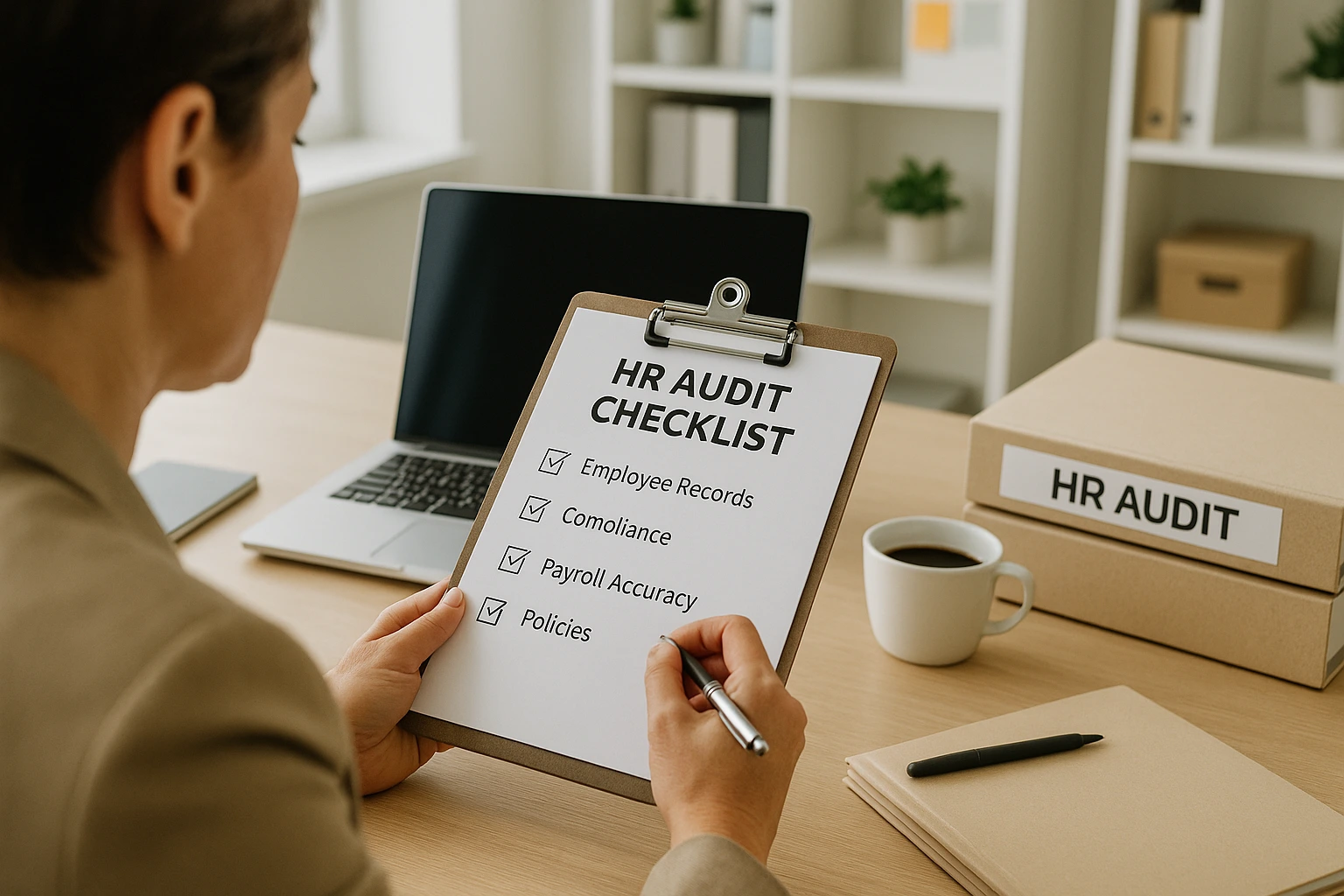
By Nandana G.S , Digital Marketing Executive
An HR audit is not only about checking whether policies and processes exist. It is also about verifying whether the organization can prove that those processes are being followed.
For businesses, maintaining proper HR records helps demonstrate compliance, identify gaps, support payroll accuracy, and stay prepared for internal reviews, statutory inspections, or employee-related disputes.
What Is HR Audit Evidence?
HR audit evidence refers to the documents, records, reports, approvals, registers, and other supporting proof that demonstrate how an organization’s HR processes are being managed.
Having a policy on paper is one thing. Being able to show evidence of its implementation is another.
1. Employee Personal and Employment Records
HR should maintain accurate records for every employee, including:
✔️ Employee application/resume ✔️ Offer or appointment letter ✔️ Joining documentation ✔️ Employment agreement, where applicable ✔️ Employee master data ✔️ Designation and department records ✔️ Salary and compensation details ✔️ Promotion or transfer records ✔️ Relevant employee declarations and forms
These records should be organized and updated whenever employee information changes.
2. Attendance and Leave Records
Attendance and leave documentation is important for both HR administration and payroll verification.
Companies should maintain:
-
Attendance records
-
Leave applications and approvals
-
Leave balances
-
Late-coming or absence records, where applicable
-
Overtime records, where applicable
-
Working-hours records
The records should be consistent with the information used for payroll processing.
3. Payroll and Salary Records
Payroll is one of the key areas reviewed during an HR audit.
Evidence may include:
✔️ Salary registers ✔️ Payroll processing reports ✔️ Payslips ✔️ Salary structure records ✔️ Deductions and recoveries ✔️ Overtime or incentive calculations ✔️ Full & Final settlement records ✔️ Payroll reconciliation reports
HR and payroll teams should be able to explain significant variations or adjustments.
4. Statutory Compliance Records
Companies should maintain appropriate evidence relating to applicable statutory requirements.
Depending on the organization’s applicability, this may include records relating to:
-
PF
-
ESI
-
Professional Tax
-
TDS
-
Labour Welfare Fund
-
Gratuity
-
Applicable labour-law registers and returns
-
Statutory payments and acknowledgements
The exact records required can vary based on the organization’s location, workforce, and applicable laws.
5. HR Policies and Employee Acknowledgements
Having policies is not enough. Organizations should also maintain evidence that employees have been informed about relevant policies.
Examples include:
✔️ Employee handbook ✔️ Leave policy ✔️ Attendance policy ✔️ Code of conduct ✔️ POSH policy ✔️ Work-from-home policy ✔️ Disciplinary policy ✔️ Policy acknowledgement records
Whenever policies are updated, HR should maintain appropriate communication and acknowledgement records.
6. Recruitment and Onboarding Records
An HR audit may also examine whether recruitment and onboarding processes are properly documented.
Keep records such as:
-
Job descriptions
-
Interview evaluation forms
-
Selection approvals
-
Offer letters
-
Joining checklists
-
Onboarding documentation
-
Employee induction records
-
Background verification records, where applicable
A standardized recruitment file can make the audit process much easier.
7. Performance Management Records
Performance-related decisions should have supporting documentation.
HR may maintain:
✔️ Performance appraisal records ✔️ Goal-setting documents ✔️ Performance review forms ✔️ Feedback records ✔️ Performance improvement plans ✔️ Promotion recommendations ✔️ Increment approvals
Proper documentation can help demonstrate that employment decisions were based on an established process.
8. Training and Development Records
Organizations should maintain evidence of employee development activities.
This can include:
-
Training calendars
-
Attendance records
-
Training completion certificates
-
Skill development records
-
Training feedback
-
POSH awareness/training records
-
Other mandatory or role-specific training records
9. Disciplinary and Grievance Records
Where disciplinary or grievance matters arise, HR should maintain appropriate documentation.
Depending on the situation, this may include:
-
Employee complaints
-
Written explanations
-
Show-cause notices
-
Warnings
-
Investigation records
-
Management decisions
-
Grievance resolution records
These records should be handled with appropriate confidentiality and access controls.
10. Employee Exit Documentation
The employee exit process should also have a complete documentation trail.
HR should maintain:
✔️ Resignation letter/email ✔️ Resignation acceptance ✔️ Notice-period records ✔️ Handover documentation ✔️ Clearance records ✔️ Asset-return confirmation ✔️ Exit interview, where conducted ✔️ Full & Final settlement ✔️ Relieving and experience documents
A properly documented exit process can help reduce misunderstandings after separation.
11. HR Audit Trail and Approvals
One commonly overlooked area is proof of approvals and decision-making.
Organizations should retain appropriate evidence such as:
-
Management approvals
-
Salary revision approvals
-
Leave approvals
-
Hiring approvals
-
Policy approvals
-
Exception approvals
-
HR communications
-
Relevant email trails
This helps auditors understand not just what happened, but who authorized it and when.
12. Digital Records and Access Control
Modern HR departments increasingly rely on digital HRMS and payroll systems.
Companies should ensure that digital records are:
✔️ Properly organized ✔️ Backed up ✔️ Accessible to authorized personnel ✔️ Protected from unauthorized access ✔️ Retained according to applicable requirements
Important documents should not exist only in individual employees’ personal email accounts or local computer folders.
Common HR Audit Evidence Gaps
Businesses often face problems because they:
❌ Have policies but no acknowledgement records ❌ Maintain incomplete employee files ❌ Have payroll records that don’t match HR records ❌ Cannot produce approval trails ❌ Maintain inconsistent attendance and leave data ❌ Miss statutory payment or filing evidence ❌ Store documents across disconnected systems ❌ Fail to maintain proper exit documentation
HR Audit Evidence Checklist
A simple audit-ready HR file structure can include:
Employee Records → Recruitment → Onboarding → Attendance & Leave → Payroll → Statutory Compliance → Policies → Performance → Training → Grievances → Disciplinary Records → Exit Documentation → Approvals & Audit Trail
The goal is not to create paperwork for the sake of paperwork. The goal is to ensure that every important HR process has reliable supporting evidence.
How Level Up HR Solutions Can Help
At Level Up HR Solutions, we help businesses strengthen their HR systems through HR audits, HR documentation, payroll compliance, statutory compliance reviews, employee record management, and policy support.
An HR audit can help identify documentation gaps before they become larger compliance or operational problems.
Final Thoughts
Being audit-ready means more than having a collection of HR documents. Companies need a structured system where records are accurate, updated, traceable, and easy to retrieve.
When HR teams maintain proper evidence throughout the employee lifecycle, they can improve compliance, strengthen internal controls, and respond more confidently to audits and inspections.
Start building your HR audit file before you need it—not when an audit arrives.
Level Up HR Solutions 📞 +91 8714805999 📧 info@leveluphrs.com 🌐 www.leveluphrs.com
#HRAudit #HRAuditChecklist #HRCompliance #HRDocumentation #PayrollCompliance #StatutoryCompliance #EmployeeRecords #HRManagement #HRIndia #AuditReady #KeralaBusiness #KochiBusiness #LevelUpHRSolutions