
By, Nandana GS , Digital Marketing Executive
Let me ask you something uncomfortable.
When was the last time you actually looked at the candidates your Applicant Tracking System (ATS) silently filtered out?
Not the ones who made it to your inbox. Not the ones who got a polite “We’ll keep your resume on file.” I mean the ones your ATS auto-rejected – often within seconds – because they didn’t have the “right” keyword, the “right” job title, or the “right” graduation year.
Here’s the hard truth that most HR leaders don’t want to admit:
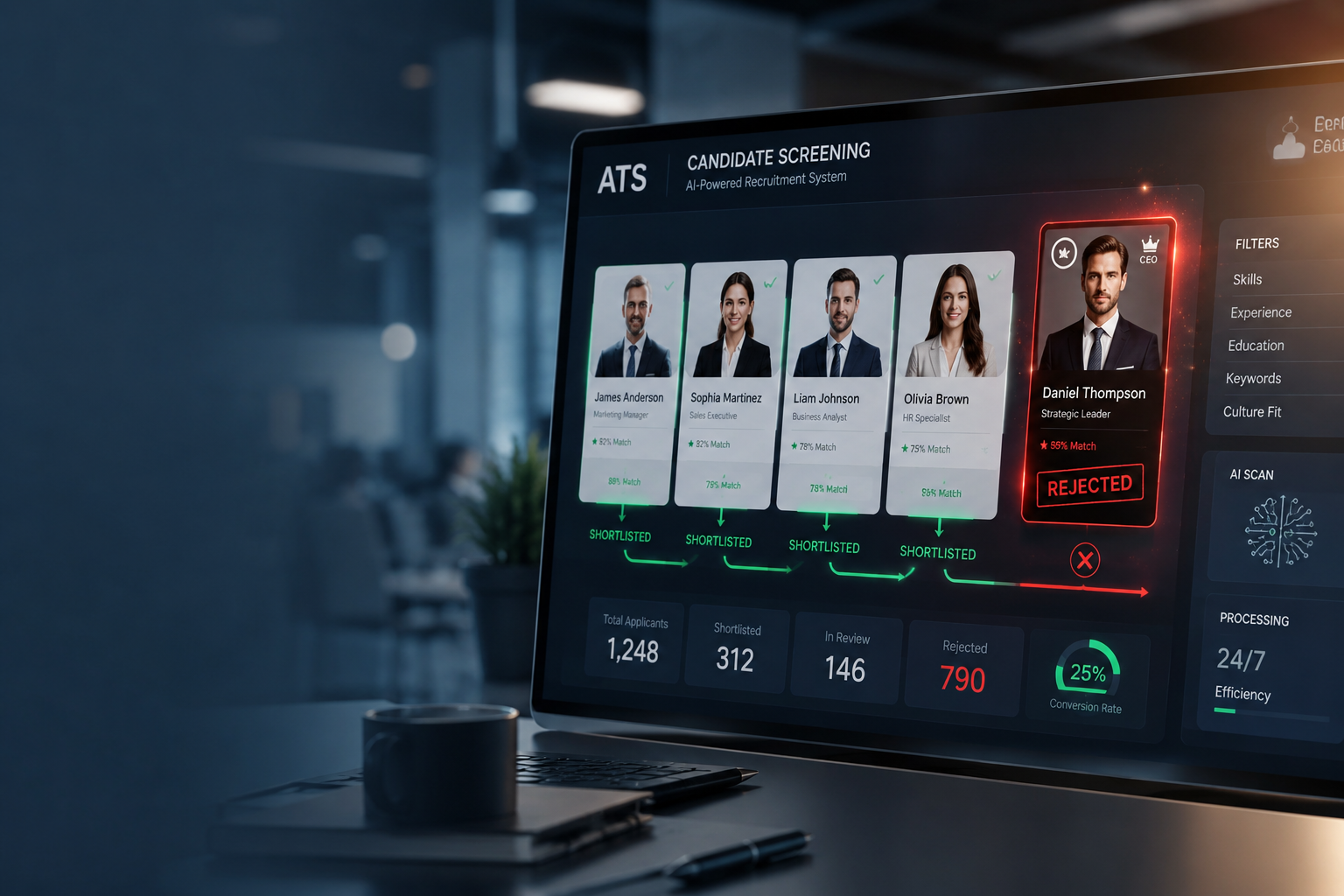
Your ATS is not a neutral gatekeeper. It is a high-speed, bias-reinforcing machine that is systematically rejecting your company’s future leaders.
And if you don’t fix it, your competitors will happily hire them instead.
The False Comfort of Automation
I get it. You’re drowning in applications. For every open role, you might receive 250+ resumes. You can’t read them all manually. So you turn to your ATS to “help.”
You set up keyword filters:
- Must have “Salesforce”
- Must have “5+ years of people management”
- Must have “MBA or equivalent”
- Must have “agile” and “Scrum”
And just like that, you’ve built a digital wall that lets through the safe candidates – the ones who look exactly like the last person who held the job.
But here’s what you’ve also done:
You’ve rejected the career-changer who spent four years as a military logistics officer. She has never used Salesforce, but she led 200 people through a supply chain crisis in a combat zone. Your ATS gave her a 14% match.
You’ve rejected the self-taught coder who dropped out of college to care for a sick parent. He doesn’t have a degree, but he built an app that 50,000 people use. Your ATS gave him 0 points for “education”.
You’ve rejected the neurodivergent project manager who took a two-year gap after burnout. Her resume doesn’t follow the standard reverse-chronological format. Your ATS couldn’t parse it at all.
None of these people are “unqualified”. They just failed an automated test that was never designed to measure real leadership potential.
Why ATS Bias Is Worse Than You Think
Let’s talk about the data, because this isn’t just a feeling – it’s a measurable problem.
A famous Harvard Business School study found that 88% of resumes from older, highly qualified workers are rejected by ATS systems because of date-related filters (e.g., “graduation year after 2010”).
Another study from the Technology & Engineering Management Conference revealed that ATS keyword matching algorithms are wrong up to 75% of the time when evaluating candidates with non-traditional career paths.
And here’s the kicker: Most ATS vendors train their algorithms on historical hiring data – which means they learn and amplify your company’s past biases. If you’ve historically hired mostly white male graduates from top 20 universities, your ATS will systematically prioritize resumes that look like that.
It’s not “artificial intelligence.” It’s automated groupthink.
The “Future Leader” Profile Your ATS Can’t See
Think about the best leader you’ve ever worked with. Was it the person with the most linear resume? The one who checked every single box?
Probably not.
Great leaders often have messy, non-linear paths. They’ve changed industries. They’ve started failed side businesses. They’ve taken sabbaticals. They’ve worked in roles with weird titles that don’t match standard taxonomies.
These are precisely the people your ATS is trained to discard.
Let me give you a real example.
A few years ago, a Fortune 500 company was hiring for a Head of Innovation. Their ATS filtered 1,200 applications down to 47 based on keywords: “innovation,” “disruption,” “patents,” “startup,” “PhD.”
One of the rejected candidates was a former high school teacher who had never worked in corporate. She had no “innovation” keyword. But she had redesigned the entire science curriculum for her district, launched a grant-funded maker space, and convinced 12 other schools to adopt her model – all on a shoestring budget.
A human finally saw her resume by accident. She was hired. Within 18 months, she had launched three new product lines that generated $40M in revenue.
The ATS said no. A human said yes. And the company made millions.
How many of those people are you saying no to every single week?
The Hidden Costs of ATS Rejection
You’re probably thinking: “But we can’t possibly review every resume.”
I’m not suggesting you should. What I am suggesting is that you quantify what you’re losing.
Let’s do the math.
Assume you post one senior-level role. You get 300 applications. Your ATS filters out 80% based on keyword mismatches, formatting issues, and date cutoffs. That leaves 60 candidates for a human to review.
Of the 240 rejected, let’s say just 5% (12 people) were genuinely high-potential – future leaders who could have grown into the role or adjacent roles.
Now multiply that by 50 roles per year. That’s 600 future leaders rejected annually – people who could have become your top performers, your succession pipeline, your culture carriers.
What does it cost to lose 600 high-potential people? Recruiting costs. Training costs. Lost productivity. Turnover from the mediocre hires who did get through. And the hardest cost of all: the innovation and fresh thinking that never enters your building.
How to Fix Your ATS – Without Ditching It Entirely
I’m not naïve enough to tell you to throw out your ATS. You need some kind of system.
But you can dramatically reduce the false negatives with five practical changes.
1. Kill the “must-have” keyword list – replace it with a “nice-to-have” tier
Most ATS systems let you weight keywords. Stop using binary filters (must have / reject). Instead, create a three-tier system:
- Core required (maximum 3 items – e.g., “legal right to work in this country”)
- Strongly preferred (up to 5 items – assign points, not knockout)
- Nice to have (everything else)
Resumes that miss all “core required” get auto-rejected. Everything else goes to a human for review, with a score not a gate.
2. Remove graduation years and GPA requirements
Unless you’re hiring for a role where age is a bona fide occupational qualification (almost never), graduation year is a bias machine. It screens out career-changers, late-degree completers, and anyone over 40.
Similarly, GPA correlates poorly with leadership potential. Remove it entirely from ATS filters.
3. Audit your ATS every quarter with “test resumes”
Create 10 fictional resumes that represent non-traditional but high-potential candidates:
- A military veteran with no corporate experience
- A stay-at-home parent returning after 6 years
- A candidate with a degree from an unknown international university
- A self-taught professional with certificates instead of degrees
Run them through your ATS. See what score they get. If any fall below 20%, your system is broken.
4. Turn off “auto-reject” for formatting errors
Many ATS systems reject resumes that use tables, columns, graphics, or non-standard fonts (common in creative fields, academic CVs, and international formats). Change your settings to flag formatting issues but not auto-reject. A human can glance at a funky PDF in 3 seconds and decide if the content matters.
5. Implement a “blind human review” pilot for all senior roles
For any role above a certain level (say, director or above), require that every single application be reviewed by at least one human – even if only for 10 seconds.
Why? Because senior roles are where unconventional backgrounds shine brightest. And because the cost of a false negative (missing your next VP) is astronomical compared to the cost of 10 extra minutes of recruiter time.
But What About Scale? (The Startup vs. Enterprise Question)
I can already hear the pushback: “We get 10,000 applications a month. We can’t manually review everything.”
Fair. But here’s a distinction most people miss:
Volume filtering is different from leadership filtering.
For high-volume frontline roles (retail associates, customer support agents), aggressive ATS filtering may be necessary – though still problematic.
But for leadership roles – manager, director, VP, or any role that will eventually manage others or shape strategy – you must use a lighter touch.
You are not hiring for keywords. You are hiring for judgement, resilience, curiosity, and influence. None of those things appear in a boolean search string.
So segment your ATS rules by role type:
- High volume, low complexity → tighter filters
- Leadership potential roles → minimal filters + guaranteed human review
This isn’t about perfection. It’s about not rejecting your future CEO because she used the word “spearheaded” instead of “led.”
A Challenge for Every HR Leader Reading This
I want you to do something this week.
Go into your ATS and pull the last 200 auto-rejected applications for a single mid-level or senior role. Don’t look at the reasons yet.
Pick 20 at random. Download the original resumes.
Read them. Actually read them – not for keywords, but for signal.
Does this person show:
- Problem-solving in an unusual context?
- The ability to learn something hard without formal training?
- Resilience through a career setback?
- The desire to grow into a role, not just check boxes?
I’ll bet you find at least 3 out of those 20 that make you say, “Why did we reject this person?”
That’s your evidence. That’s your mandate to change.
The Bottom Line
Your ATS is not your enemy. But it is a blunt instrument.
And blunt instruments have no place identifying future leaders – people whose value will never be captured by keyword matching, gap-year algorithms, or rigid format requirements.
The companies that win the next decade of talent will not be the ones with the most sophisticated ATS. They will be the ones brave enough to trust humans after the filter, not instead of it.
So here’s my question for you:
How many future leaders did your ATS reject today?
If you can’t answer that question, your system is broken.
And it’s time to fix it.