

How Hiring for Skills Instead of Degrees Is Shaping the Future of Talent Acquisition
The recruitment landscape is undergoing one of its biggest transformations in decades. For years, organizations relied heavily on academic qualifications, years of experience, and prestigious job titles to identify the right candidates. While these factors still hold value, they are no longer the strongest indicators of workplace success.
Today, businesses are recognizing that skills, competencies, and the ability to learn are far better predictors of employee performance than qualifications alone. Consequently, organizations across industries are shifting toward skills-based hiring—a recruitment approach that focuses on what candidates can actually do rather than simply where they studied or how long they have worked.
As technology continues to evolve and job roles change rapidly, this hiring model is becoming essential for building agile, innovative, and future-ready workforces.
What Is Skills-Based Hiring?
Skills-based hiring is a recruitment approach where candidates are evaluated primarily on their knowledge, practical abilities, competencies, and potential rather than solely on their educational qualifications or years of experience.
Instead of asking:
- Which university did the candidate attend?
- How many years of experience do they have?
Employers are increasingly asking:
- Can this person perform the job successfully?
- Do they possess the technical and behavioural skills required?
- Can they learn and adapt quickly?
Therefore, hiring decisions are based on capability rather than credentials.
Why Traditional Recruitment Is No Longer Enough
For many years, recruitment followed a predictable pattern. Employers created job descriptions that emphasized:
- Bachelor’s or Master’s degrees
- Minimum years of experience
- Previous job titles
- Industry background
Although this approach helped standardize hiring, it also created several limitations.
Many highly capable professionals were overlooked simply because they lacked a particular degree or did not meet an arbitrary experience requirement. At the same time, some candidates with impressive resumes failed to perform effectively because practical skills were never properly assessed.
Consequently, organizations began realizing that traditional hiring methods were excluding valuable talent.
Why Skills-Based Hiring Is Growing in 2026
Several workplace trends are accelerating the shift toward skills-first recruitment.
1. Technology Is Changing Jobs Faster Than Ever
Artificial Intelligence, automation, cloud computing, and digital transformation are continuously changing job requirements.
Many skills that were relevant five years ago are already becoming outdated.
Therefore, organizations need employees who can:
- Learn continuously
- Adapt to new technologies
- Solve emerging business challenges
Rather than hiring based solely on past experience, companies are prioritizing candidates who demonstrate learning agility and practical competence.
2. Degrees Do Not Always Reflect Job Readiness
A university degree provides theoretical knowledge, but it may not always prepare candidates for real workplace challenges.
For example, two applicants may hold the same qualification, yet one may possess significantly stronger communication, analytical thinking, and problem-solving abilities.
Consequently, organizations are increasingly using:
- Practical assessments
- Case studies
- Simulation exercises
- Technical evaluations
- Portfolio reviews
These methods provide a more accurate picture of a candidate’s ability.
3. Skills Shortages Are Increasing
Across industries, employers are facing significant shortages of skilled professionals.
Limiting recruitment to candidates with specific degrees or backgrounds narrows the talent pool.
Skills-based hiring enables organizations to recruit:
- Career changers
- Self-taught professionals
- Certified learners
- Freelancers
- Professionals returning to work
- Candidates from diverse industries
As a result, businesses gain access to a much broader talent market.
4. Artificial Intelligence Is Changing Recruitment
Modern recruitment technology is making skills-based hiring easier than ever.
AI-powered recruitment platforms can:
- Match candidates based on skills
- Identify transferable competencies
- Screen assessments
- Reduce hiring bias
- Improve candidate matching
Therefore, recruiters can spend more time evaluating potential rather than filtering resumes.
Benefits of Skills-Based Hiring
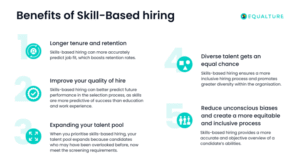
1. Better Hiring Quality
When employees are selected based on demonstrated capabilities, they are more likely to perform successfully.
Consequently:
- Productivity improves
- Training time decreases
- New hires contribute faster
2. Faster Recruitment
Lengthy recruitment processes often occur because organizations focus excessively on credentials.
Skills assessments provide objective evidence of capability, allowing recruiters to make faster hiring decisions.
3. Increased Workforce Diversity
Traditional hiring often favors candidates from particular universities or backgrounds.
Skills-based hiring creates opportunities for talented individuals regardless of:
- Educational background
- Career path
- Location
- Previous industry
As a result, organizations benefit from greater diversity of thought and innovation.
4. Improved Employee Retention
Employees who possess the right skills tend to adapt more effectively and perform with greater confidence.
Consequently, job satisfaction and long-term retention are often improved.
5. Future-Proof Workforce
Business requirements continue changing rapidly.
Hiring employees with strong learning abilities enables organizations to adapt more effectively to future challenges.
Therefore, recruitment becomes an investment in long-term organizational resilience.
Essential Skills Employers Are Looking For
Technical skills remain important, but employers are placing increasing emphasis on durable human skills.
These include:
Technical Skills
- Digital literacy
- Data analysis
- AI tools
- Software proficiency
- Cybersecurity awareness
- Cloud technologies
Soft Skills
- Communication
- Problem-solving
- Critical thinking
- Adaptability
- Collaboration
- Emotional intelligence
- Leadership
- Creativity
- Decision-making
- Time management
Employees who combine technical expertise with strong interpersonal skills are becoming the most valuable assets in today’s workplace.
How HR Can Successfully Implement Skills-Based Hiring
Transitioning to a skills-first recruitment model requires more than updating job advertisements.
HR teams should adopt a structured approach.
Review Existing Job Descriptions
Many job descriptions contain outdated qualification requirements.
Instead, focus on:
- Essential technical skills
- Behavioural competencies
- Performance expectations
- Learning capability
Redesign the Recruitment Process
Rather than relying only on resumes, incorporate:
- Skills assessments
- Practical assignments
- Role-play exercises
- Behavioural interviews
- Portfolio evaluations
This provides a more comprehensive understanding of candidate capability.
Train Hiring Managers
Managers should learn how to evaluate competencies objectively instead of relying primarily on educational credentials.
Interview questions should focus on real-world examples and demonstrated skills.
Use Skills Assessment Technology
Modern HR technology can support:
- Online testing
- AI candidate matching
- Competency mapping
- Skill gap analysis
These tools improve hiring accuracy and efficiency.
Build Internal Talent Through Upskilling
Skills-based hiring should not apply only to external recruitment.
Organizations should also identify internal employees with growth potential and provide opportunities for:
- Upskilling
- Reskilling
- Cross-functional learning
- Leadership development
This strengthens workforce capability while improving retention.
Common Challenges of Skills-Based Hiring
Although the benefits are significant, implementation may present challenges.
Organizations should prepare for:
- Resistance to changing traditional hiring practices
- Difficulty designing effective assessments
- Training hiring managers on competency evaluation
- Updating recruitment technology
- Balancing skills with cultural fit
However, these challenges can be overcome through careful planning and continuous improvement.
The Future of Recruitment
Skills-based hiring is not
a temporary trend—it represents the future of recruitment.
As technology continues to reshape industries, job roles will evolve more quickly than traditional education systems can adapt.
Organizations that prioritize skills, learning potential, and adaptability will be better positioned to attract top talent, respond to market changes, and remain competitive.
In the coming years, successful recruitment will focus less on where candidates have been and more on what they are capable of achieving.
Final Thoughts
The shift from traditional recruitment to skills-based hiring reflects a fundamental change in how organizations define talent.
While degrees and experienc
e continue to provide valuable context, they should no longer serve as the primary criteria for hiring decisions. Instead, businesses should evaluate candidates based on their demonstrated abilities, learning mindset, and potential to contribute.
By embracing skills-based hiring, organizations can expand their talent pool, improve hiring quality, reduce bias, and build a workforce that is equipped for the future of work.
For HR professionals and business leader
s, adopting this approach is no longer simply an innovation—it is a strategic necessity.
How Level Up HR Solutions Can Help
At Level Up HR Solutions, we help organizations modernize their recruitment strategies with practical, business-focused HR solutions.
Our expertise includes:
- Skills-Based Recruitment
- HR Consulting & Strategy
- Talent Acquisition
- Competency Framework Development
- HR Policy Development
- Recruitment Process Optimization
- Performance Management Systems
- HR Audits & Compliance
- Employee Training & Development
Whether you’re a startup, SME, or established enterprise, our team can help you build a future-ready workforce through smarter hiring practices.
📞 Phone: +91 8714805999 📧 Email: info@leveluphrs.com 🌐 Website: www.leveluphrs.com
#SkillsBasedHiring #Recruitment #TalentAcquisition #HRStrategy #FutureOfWork #HumanResources #Hiring #EmployeeExperience #WorkplaceTrends #Leadership #BusinessGrowth #RecruitmentStrategy #HRIndia #TalentManagement #LevelUpHRSolutions