
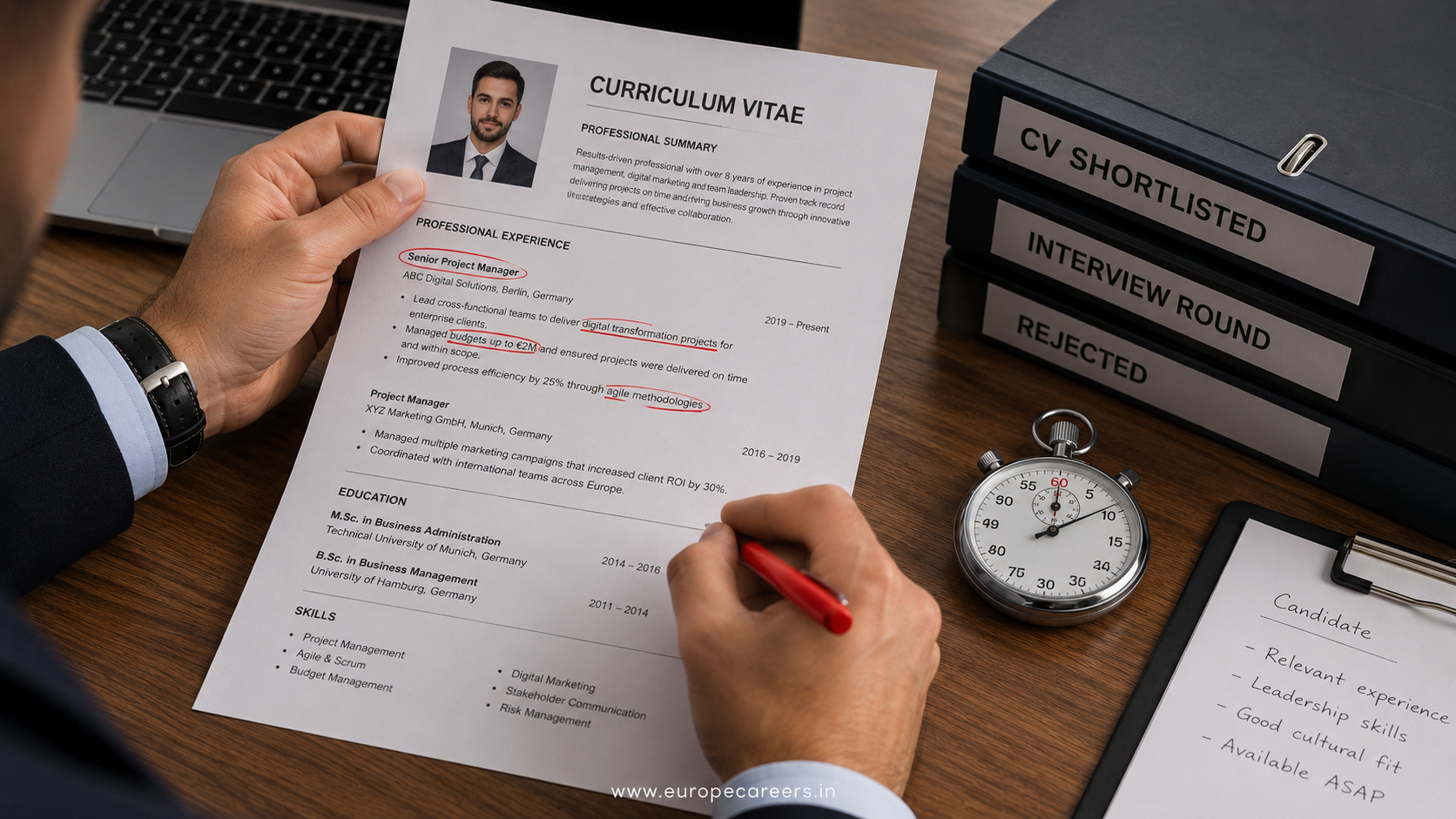
Planning to apply for jobs in Europe? Your CV is one of the most important documents in your international job application. It helps employers understand your professional background, qualifications, skills, and suitability for a position.
However, preparing a CV for international opportunities requires more than simply translating your existing resume into English. The information must be clearly structured, professionally presented, and relevant to the job market you are targeting.
One commonly used option is the Europass CV format, a standardised CV format designed to help candidates present their qualifications and experience in a clear and organised manner.
Whether you are a fresh graduate, an experienced professional, or someone planning to work abroad, understanding the Europass format can help you prepare a stronger application.
What Is a Europass CV?
A Europass CV is a standardised CV format developed as part of the European Union’s Europass initiative.
It helps individuals present their education, professional experience, language abilities, digital skills, and other competencies in a structured format that is familiar to many European employers and educational institutions.
The official Europass platform allows candidates to create, edit, download, and share their CVs online.
It is particularly useful for people applying for:
- Jobs in European countries
- International employment opportunities
- Higher education programmes
- Professional training courses
- Internships and volunteering opportunities
However, Europass is not compulsory for every European job application. Candidates should always check the employer’s instructions and the preferred CV format in the job advertisement.
Why Is the Europass CV Format Important?
When applying for international positions, employers need to understand a candidate’s qualifications and experience without confusion.
A structured CV makes it easier to review professional information and identify relevant skills.
Some important benefits include:
1. Standardised Presentation: The format provides a familiar structure for presenting education, work experience, and skills.
2. Clear Organisation: Important professional details are arranged into identifiable sections.
3. International Accessibility: Europass supports CV creation in multiple languages, making it useful for candidates targeting different European markets.
4. Easy Online Creation: Candidates can use the official Europass CV editor to prepare and download their documents.
5. Flexible Applications: Candidates can create different CV versions using relevant information from their Europass profile.
6. Skills-Based Presentation: The format provides opportunities to highlight language, digital, communication, and professional skills.
Essential Sections of a Professional Europass CV
A well-prepared Europass CV should contain relevant information that helps employers understand your professional background.
Here are the important sections to include.
1. Personal Information
This section introduces you to the employer.
Include:
- Full name
- Professional email address
- Contact number with country code
- Current location
- Relevant professional links, such as LinkedIn
Provide accurate contact details so recruiters can reach you easily.
Avoid adding unnecessary personal information. Include a photograph or additional details only when appropriate for the employer, role, or application instructions.
2. Professional Profile or About Me
Your professional profile is a short introduction highlighting your experience, qualifications, key strengths, and career focus.
It should immediately communicate what you bring to the position.
For example:
“Detail-oriented Accounts Professional with over three years of experience in financial reporting, accounts payable, accounts receivable, bank reconciliation, and accounting documentation. Skilled in maintaining accurate financial records and supporting day-to-day accounting operations.”
A strong profile should be specific to your career background rather than using generic statements.
3. Work Experience
This section explains your professional journey.
List your employment history in reverse chronological order, starting with your most recent position.
For every role, mention:
- Job title
- Company name
- Employment location
- Employment period
- Main responsibilities
- Relevant achievements
Instead of writing only general duties, describe your actual contributions.
For example:
Accounts Assistant
- Maintained daily financial transactions and accounting records.
- Assisted with accounts payable and receivable activities.
- Prepared bank reconciliation statements.
- Supported monthly financial reporting and documentation.
Use action-oriented language and include measurable achievements when accurate information is available.
4. Education and Training
Include your academic qualifications and relevant professional training.
Mention:
- Degree or qualification
- Institution name
- Location
- Year of completion
- Relevant specialisation
For professional courses, include certifications that support your target role.
Candidates with limited work experience can give greater prominence to education, internships, projects, and relevant training.
5. Language Skills
Language ability can be particularly important when applying for international positions.
Europass provides a structured way to describe language proficiency.
The Common European Framework of Reference for Languages (CEFR) uses the following levels:
| Level | Description |
|---|---|
| A1 | Beginner |
| A2 | Elementary |
| B1 | Intermediate |
| B2 | Upper Intermediate |
| C1 | Advanced |
| C2 | Proficient |
Candidates should provide honest proficiency levels based on their actual abilities.
For example:
- English – B2
- German – A2
- French – A1
Do not claim fluency or advanced proficiency unless you can demonstrate it.
6. Digital Skills
Digital skills are important across many professional industries.
Include software and tools that are relevant to your target position.
Examples:
- Microsoft Excel
- Microsoft Word
- PowerPoint
- SAP
- Tally
- QuickBooks
- Zoho Books
- Power BI
- CRM platforms
- Industry-specific software
Avoid listing every tool you have ever used. Prioritise the skills mentioned in the job description.
7. Professional and Job-Related Skills
This section allows you to highlight competencies that demonstrate your ability to perform the role.
Examples include:
- Communication
- Team collaboration
- Problem-solving
- Time management
- Leadership
- Analytical thinking
- Customer relationship management
- Project coordination
- Technical expertise
Whenever possible, connect these skills to actual work experience, projects, or achievements.
8. Certifications, Projects and Additional Information
Additional sections can strengthen your CV when they are relevant to the position.
You may include:
- Professional certifications
- Training programmes
- Academic projects
- Research work
- Publications
- Awards
- Volunteer experience
- Professional memberships
Choose information that supports your application rather than adding unrelated details.
How to Create a Europass CV Step by Step
The official Europass platform provides an online CV editor that candidates can use to prepare their CVs.
Follow these steps:
Step 1: Visit the Official Europass Website
Go to https://europass.europa.eu/en/create-europass-cv
Use the official platform rather than relying on unofficial websites claiming to provide Europass services.
Step 2: Create Your Europass Profile
Enter your education, work experience, language abilities, digital skills, and other relevant information.
You can maintain a broader profile and use selected information when preparing different CVs.
Step 3: Add Your Professional Details
Complete the relevant sections with accurate and updated information.
Review employment dates, job titles, educational qualifications, and contact details carefully.
Step 4: Select Relevant Information
Choose the experience, skills, and qualifications that best match the position you are applying for.
You do not need to include every detail from your professional history in every application.
Step 5: Review the CV Layout
Select an available design and check how the information appears.
Make sure the document is readable, properly organised, and professionally presented.
Step 6: Proofread and Download
Check spelling, grammar, dates, and formatting before downloading your final CV.
Save the document in the format requested by the employer, usually PDF when a PDF is requested.
7 Common Europass CV Mistakes to Avoid
Using the Europass template does not automatically make a CV effective. The quality of the content matters just as much as the format.
Here are some common mistakes candidates should avoid.
1. Using the Same CV for Every Job
Different positions require different qualifications and skills. Customise your CV according to the job description.
2. Writing Long and Unstructured Job Descriptions
Avoid lengthy paragraphs describing every daily activity. Use clear bullet points and prioritise relevant responsibilities and achievements.
3. Adding Irrelevant Personal Information
Focus on professional details that are relevant to the application. Follow the employer’s instructions regarding additional personal information.
4. Listing Skills Without Context
Instead of simply listing skills, demonstrate how you have applied them through your experience or projects.
5. Ignoring Language Proficiency
For international applications, language ability may be important. Mention accurate proficiency levels and relevant language qualifications.
6. Including Outdated Information
Review your employment history, contact information, qualifications, and professional skills before submitting your CV.
7. Ignoring the Employer’s Preferred Format
Not every European employer requires a Europass CV. Some organisations prefer a different CV structure or a shorter, tailored resume. Always follow the application instructions.
Is a Europass CV Suitable for Every European Job?
No. Although Europass is a well-known CV format across Europe, it is not the only acceptable format.
The suitability of a CV depends on several factors:
- The country where you are applying
- The employer’s recruitment preferences
- The industry and job position
- The level of experience required
- The instructions provided in the vacancy announcement
Some employers may prefer a concise, tailored CV rather than a full Europass-style document.
For this reason, candidates should research their target employer and job market before choosing a CV format.
The best CV is not simply the one that follows a recognised template. It is the one that presents your qualifications clearly and matches the opportunity you are applying for.
How to Make Your Europass CV More Professional
Before submitting your CV, consider these practical improvements:
- Use a professional email address.
- Keep employment dates accurate and consistent.
- Present your latest experience first.
- Include relevant industry keywords naturally.
- Highlight achievements wherever possible.
- Use clear and professional language.
- Avoid unnecessary design elements and decorative graphics.
- Check spelling, grammar, and formatting.
- Tailor your professional profile to each application.
- Ensure all information is genuine and verifiable.
Also remember that a recognised CV template does not guarantee an interview or selection. Employers may use different recruitment systems and evaluation methods.
How Level Up HR Solutions Can Help
Preparing a professional CV for international opportunities requires more than arranging information in a template. It requires understanding the candidate’s career background, identifying relevant skills, and presenting professional experience in a clear and organised manner.
At Level Up HR Solutions, we support job seekers with professional CV and career-documentation services.
Our support includes:
- Professional CV Writing: Professionally structured CVs based on your qualifications, experience, and career goals.
- Europass CV Preparation: Assistance with organising professional information in the Europass format.
- ATS-Friendly CV Structuring: Clear formatting and relevant keyword placement to support recruitment-system readability.
- LinkedIn Profile Optimisation: Improving your professional online presence and career presentation.
- Cover Letter Writing: Tailored cover letters that support your job applications.
- CV Review and Improvement: Identifying gaps in content, presentation, and professional positioning.
Whether you are a fresher or an experienced professional planning to apply abroad, a well-prepared CV can help you present your career profile more confidently.
Final Thoughts
A Europass CV provides a recognised and structured way to present your qualifications, work experience, and skills for opportunities across Europe.
However, selecting the right format is only the first step. Your CV must also contain accurate information, relevant skills, clear descriptions, and a professional presentation.
Before applying for any international position, review the employer’s requirements and customise your CV accordingly.
Your experience deserves to be presented clearly. Make your CV a professional reflection of your career journey.
Level Up HR Solutions
Professional CV Writing & Career Support
📞 +91 8714805999
📧 info@leveluphrs.com
🌐 www.leveluphrs.com
#EuropassCV #EuropassFormat #EuropeanCV #ProfessionalCV #CVWriting #InternationalJobs #JobsInEurope #ATSFriendlyCV #ResumeWriting #CoverLetter #CareerDevelopment #JobSearchTips #LevelUpHRSolutions