
29May

Employee Satisfaction Isn’t Employee Engagement

By Nandana G.S Level Up HR Solutions

In many organizations, employee engagement and employee satisfaction are often used interchangeably. However, this assumption is fundamentally flawed. While both concepts are related, they represent very different outcomes and business impacts.

Therefore, it is essential that this distinction is clearly understood—especially by HR leaders and business decision-makers.

What Is Employee Satisfaction?

Employee satisfaction refers to how comfortable and content employees feel in their workplace.

It is typically influenced by factors such as:

  • Salary and benefits
  • Work environment
  • Job security
  • Policies and perks

As a result, satisfied employees are generally happy with their conditions. However, satisfaction does not necessarily translate into performance or contribution.

What Is Employee Engagement?

Employee engagement, on the other hand, refers to the emotional commitment and involvement an employee has toward their work and the organization.

Engaged employees:

  • Take initiative
  • Go beyond assigned responsibilities
  • Actively contribute to business goals

Therefore, engagement is directly linked to performance, productivity, and growth.

The Key Difference

The distinction between satisfaction and engagement can be summarized as follows:

  • A satisfied employee may say: “I’m comfortable here.”
  • An engaged employee is more likely to say: “I want to contribute and make an impact.”

Consequently, satisfaction is passive, while engagement is active.

Why This Difference Matters

Many organizations invest heavily in improving satisfaction—through perks, benefits, and workplace facilities.

However, if engagement is not addressed:

  • Productivity may remain low
  • Innovation may be limited
  • Employees may stay, but not perform

As a result: businesses may struggle to achieve real growth despite having “happy” employees.

Common Misconceptions

Several misconceptions lead to confusion between the two concepts:

  • Higher salaries automatically create engagement ❌
  • Happy employees are always productive ❌
  • Perks and benefits drive long-term commitment ❌

In reality, these factors improve satisfaction but do not guarantee engagement.

What Actually Drives Engagement

To move beyond satisfaction, organizations must focus on deeper drivers:

✔️ Meaningful Work

Employees must feel that their work has purpose and impact.

✔️ Recognition and Appreciation

Consistent acknowledgment strengthens motivation and commitment.

✔️ Growth Opportunities

Learning and career progression are essential for sustained engagement.

✔️ Strong Leadership

Transparent and supportive leadership builds trust and alignment.

✔️ Open Communication

Employees must feel heard, informed, and involved.

The Risk of Focusing Only on Satisfaction

If organizations focus only on satisfaction:

  • Employees may become comfortable but disengaged
  • Performance may plateau
  • Accountability may decline

Therefore, satisfaction alone is not sufficient for business success.

How HR Can Bridge the Gap

HR must take a strategic approach to shift from satisfaction to engagement:

  • Design performance-driven systems
  • Align roles with organizational goals
  • Build recognition and feedback mechanisms
  • Train leaders to drive engagement

As a result: employees move from passive participation to active contribution.

Final Thoughts

In conclusion, while employee satisfaction ensures that employees are comfortable, employee engagement ensures that they are committed, productive, and aligned with business goals.

Therefore, organizations must not stop at making employees happy—they must focus on making them involved, motivated, and driven.

Because in the end: 👉 Satisfied employees stay. Engaged employees perform.

How Level Up HR Solutions Can Help

At Level Up HR Solutions, strategic HR frameworks are designed to help organizations move beyond satisfaction and build true engagement.

From performance management to employee experience design and leadership alignment, end-to-end solutions are provided to drive measurable results.


27May

Employee Engagement Hacks for Small Businesses

By Nandana G.S , Digital Marketing Executive , Level Up HR Solutions

Employee engagement is often associated with large organizations that have extensive resources, perks, and dedicated HR teams. However, this assumption is misleading. In reality, engagement is not driven by budget—it is driven by culture, leadership, and consistency.

Therefore, even small businesses with limited resources can build a highly engaged workforce by focusing on the right fundamentals.

Why Engagement Matters for Small Businesses

For small businesses, every employee plays a critical role. Consequently, disengagement can have a more immediate and visible impact.

When engagement is low:

  • Productivity is reduced
  • Employee turnover increases
  • Customer experience may suffer

On the other hand, high engagement leads to:

  • Stronger team collaboration
  • Better performance
  • Higher retention

Hence, investing in engagement is not optional—it is essential for growth.

The Biggest Misconception: Engagement Requires Money

Many small business owners believe that engagement requires expensive perks, bonuses, or large-scale initiatives.

However, research and practical experience show that employees value:

  • Recognition
  • Respect
  • Growth opportunities
  • Clear communication

These factors can be implemented with minimal or no financial investment.

High-Impact, Low-Cost Engagement Strategies
1. Build Strong Communication Practices

Firstly, clear and consistent communication must be established.

This can be achieved through:

  • Weekly team check-ins
  • Open discussions with leadership
  • Encouraging employee feedback

As a result: employees feel heard, valued, and connected.

2. Recognize and Appreciate Employees Regularly

Recognition does not need to be expensive to be effective.

Simple actions such as:

  • Public appreciation during meetings
  • Personalized thank-you messages
  • Highlighting achievements

can significantly boost morale.

Therefore: consistency matters more than cost.

3. Offer Growth and Learning Opportunities

Even without large training budgets, development can be supported.

Practical approaches include:

  • Internal knowledge-sharing sessions
  • Mentorship within the team
  • Assigning new responsibilities

Consequently: employees feel invested in and motivated to grow.

4. Create a Positive Work Environment

Workplace culture plays a major role in engagement.

This includes:

  • Respectful communication
  • Supportive leadership
  • A sense of belonging

Hence: a positive environment can be built without financial investment.

5. Provide Flexibility Where Possible

Flexibility is one of the most valued benefits today.

Even small businesses can offer:

  • Flexible working hours
  • Work-from-home options (where feasible)
  • Understanding of personal needs

As a result: employee satisfaction and loyalty are improved.

6. Involve Employees in Decision-Making

Employees feel more engaged when they are included in decisions.

This can be done by:

  • Asking for input on processes
  • Involving teams in problem-solving
  • Encouraging idea sharing

Therefore: ownership and accountability are increased.

7. Build Strong Manager-Employee Relationships

In small businesses, leadership accessibility is an advantage.

Managers should:

  • Have regular one-on-one conversations
  • Provide constructive feedback
  • Show genuine interest in employees

Consequently: trust and engagement are strengthened.

8. Celebrate Small Wins

Celebrations do not need to be large or expensive.

Examples include:

  • Team appreciation moments
  • Acknowledging milestones
  • Informal team gatherings

As a result: motivation and team spirit are maintained.

Common Mistakes Small Businesses Should Avoid

Even with good intentions, certain mistakes can reduce engagement:

  • Ignoring employee feedback
  • Being inconsistent in communication
  • Recognizing only top performers
  • Overloading employees without support

Hence: consistency and fairness must be maintained.

A Simple Engagement Framework for Small Businesses

To make implementation easier, a structured approach can be followed:

  1. Assess current engagement levels
  2. Identify key challenges
  3. Focus on 2–3 high-impact initiatives
  4. Implement consistently
  5. Collect feedback and improve
Final Thoughts

In conclusion, employee engagement is not determined by the size of the budget—it is shaped by the quality of leadership and workplace culture.

Small businesses, in fact, have a unique advantage: closer teams, faster communication, and more flexibility. When these strengths are effectively utilized, a highly engaged workforce can be built without significant financial investment.

Therefore, the focus should not be on spending more, but on doing the right things consistently.

How Level Up HR Solutions Can Help

At Level Up HR Solutions, tailored HR strategies are designed specifically for small and growing businesses.

From employee engagement frameworks to HR policy design and performance management systems, practical and cost-effective solutions are provided to drive real results.

20May

India’s 2026 Labour Laws: Prepare Before It’s Late

By, Nandana GS , Digital Marketing Executive , Levelup HR Solutions

As India approaches the full implementation of its reformed labour framework, a significant shift in workforce regulation is expected. The consolidation of multiple laws into four labour codes has been designed to simplify compliance. However, at the same time, stricter enforcement and higher accountability will be introduced.

Therefore, businesses are required to move beyond basic awareness and focus on structured preparation. In this blog, the key areas that must be addressed before 2026 are outlined in a clear and practical manner.

1. Understanding the Four Labour Codes

Firstly, it is essential that the foundation of the new framework is clearly understood. The four labour codes have been introduced to replace numerous outdated laws.

These include:

  • Code on Wages
  • Industrial Relations Code
  • Occupational Safety, Health and Working Conditions Code
  • Code on Social Security

Although simplification has been promised, interpretation challenges may still arise. Consequently, misalignment in policies may occur if clarity is not achieved early.

Hence, it is recommended that:

  • Legal provisions are studied in detail
  • HR teams are trained on code-specific implications
  • Expert consultation is considered before implementation
2. Salary Structure and Wage Compliance

Under the new regulations, a standardized definition of “wages” has been introduced. As a result, salary structures will be directly impacted.

In many cases, it is expected that:

  • Basic pay components will be increased
  • Allowance structures will be limited
  • Statutory contributions (PF, gratuity) will rise

Therefore, financial planning must be aligned with compliance requirements.

To ensure readiness:

  • Salary structures should be redesigned
  • Payroll systems must be updated
  • Cost implications should be forecasted in advance
3. Increased Focus on Social Security

Another major shift will be seen in the expansion of social security coverage. Not only full-time employees, but also gig and platform workers are expected to be included.

As a result:

  • Employer obligations may increase
  • Contribution tracking will become more complex
  • Compliance monitoring will be more rigorous

Thus, it is advisable that:

  • Workforce classifications are clearly defined
  • Contracts are aligned with legal requirements
  • Social security contributions are accurately managed
4. Working Hours, Leave, and Overtime Regulations

In addition, changes in working hours and leave policies are expected to be implemented with stricter enforcement.

Although flexibility may be introduced, compliance standards will be closely monitored. Consequently, organizations using outdated tracking systems may face challenges.

Common risk areas include:

  • Improper overtime calculations
  • Non-compliant leave policies
  • Lack of accurate attendance records

Therefore:

  • Automated systems should be adopted
  • HR policies must be updated
  • Real-time monitoring mechanisms should be implemented
5. Mandatory Documentation and Digital Compliance

Furthermore, documentation requirements will be strengthened. Manual processes will gradually be replaced by digital compliance systems.

As a result:

  • Inspection readiness will become critical
  • Real-time data access may be required by authorities
  • Non-compliance penalties may be imposed quickly

To stay prepared:

  • Employee records should be digitized
  • Compliance dashboards can be implemented
  • Documentation should be standardized across departments
6. Labour Inspections and Compliance Audits

In 2026, labour inspections are expected to become more transparent and technology-driven. Randomized inspections and digital reporting systems may be widely used.

However, many organizations remain reactive rather than proactive. Consequently, compliance gaps may only be identified during inspections.

Hence, it is strongly recommended that:

  • Internal audits are conducted periodically
  • Mock inspections are carried out
  • Compliance checklists are updated regularly
7. Policy Alignment and HR Capability Building

Finally, even the best policies will fail if proper execution is not ensured. In many organizations, a gap exists between compliance design and implementation.

As a result:

  • Misinterpretations may occur
  • Inconsistent practices may be followed
  • Legal risks may increase

Therefore:

  • HR teams should be continuously trained
  • Leadership must be aligned with compliance goals
  • External experts should be engaged when necessary
Final Thoughts

In conclusion, the 2026 labour law reforms will not only change how compliance is managed but also how organizations structure their workforce strategies. While the transition may appear complex, it can be effectively managed through early planning and systematic execution.

Therefore, businesses that act proactively will be better positioned to avoid penalties, enhance operational efficiency, and build a compliant and resilient workforce.

How Level Up HR Solutions Can Support You

At Level Up HR Solutions, comprehensive support is provided to help businesses navigate labour law changes with confidence. From compliance audits to payroll restructuring and policy implementation, end-to-end solutions are delivered with precision.

19May

Ignoring Labour Laws in 2026? Here’s What It Can Cost You

By, Rose Maria Francis

Digital Marketing Executive, Level Up HR Solutions

In 2026, labour law compliance is being enforced more strictly than ever before. With increased digitization, real-time tracking, and employee awareness, even minor compliance gaps are being identified quickly. As a result, businesses that fail to align with statutory requirements are being exposed to significant financial, legal, and operational consequences.

The 2026 Compliance Landscape: What Has Changed?

In recent years, labour law frameworks have been consolidated and digitized. Consequently, compliance tracking is being automated through portals, inspections are becoming data-driven, and violations are being flagged instantly.

Furthermore, employees are being empowered with better access to legal information. Therefore, even small discrepancies are being reported more frequently.

Hidden Costs of Non-Compliance (Beyond Penalties)
1. Compounded Financial Liabilities

Not only are fines being imposed, but interest and penalties are also being accumulated over time. In many cases, retrospective compliance checks are resulting in years of unpaid dues being recovered at once.

2. Loss of Government Benefits and Licenses

Additionally, non-compliant businesses are being restricted from accessing government schemes, subsidies, and tenders. Licenses may also be suspended or cancelled in severe cases.

3. Increased Audit Scrutiny

Once a violation is detected, frequent inspections are being triggered automatically. Consequently, businesses are being placed under continuous monitoring.

4. Leadership Accountability Risks

In certain cases, directors and business owners are being held personally liable. Therefore, compliance failures are no longer limited to organizational risk—they are becoming personal legal risks.

5. Digital Compliance Trail Exposure

With digital records being maintained across platforms, inconsistencies in payroll, attendance, or filings are being easily cross-verified. As a result, manipulation or errors are being detected instantly.

High-Risk Areas Businesses Cannot Ignore in 2026
Payroll Compliance

Salary structuring, minimum wage adherence, and statutory deductions must be aligned precisely. Even minor miscalculations are being flagged during audits.

PF, ESI, and Social Security

Delayed or incorrect contributions are being penalized heavily. Moreover, employee grievances related to these benefits are increasing.

Employment Contracts & Policies

Outdated contracts are being considered non-compliant. Policies related to working hours, leave, termination, and workplace conduct must be clearly defined.

HR Documentation & Registers

Incomplete or improperly maintained documentation is one of the most common reasons for penalties. Digital records are now being preferred during inspections.

Gig Workforce & Contract Labour

With the rise of gig and contractual employment, classification errors are becoming a major compliance risk.

Real Business Impact: What Companies Are Facing
  • Sudden labour inspections disrupting daily operations
  • Employee complaints escalating into legal disputes
  • Financial strain due to backdated compliance payments
  • Loss of investor confidence due to compliance gaps
  • Delays in business expansion due to regulatory issues

Therefore, the cost of non-compliance is not just financial—it is strategic.

Preventive Compliance Strategy for 2026
1. Compliance Audits Must Be Periodic

Regular internal audits should be conducted to identify gaps before authorities do.

2. Documentation Should Be Digitized

All employee records, contracts, and statutory registers must be maintained in a centralized digital system.

3. Payroll Systems Must Be Standardized

Automated payroll systems should be implemented to reduce errors and ensure statutory alignment.

4. Legal Updates Must Be Monitored

Labour laws are evolving continuously. Therefore, businesses must stay updated with amendments and notifications.

5. HR Teams Must Be Trained

Internal HR teams should be trained regularly on compliance requirements and best practices.

Why Compliance Is a Growth Strategy (Not Just a Legal Requirement)

It should be understood that compliance is not merely about avoiding penalties. Instead, it is being recognized as a foundation for sustainable growth.

  • Investor confidence is being strengthened
  • Employee trust is being improved
  • Brand reputation is being enhanced
  • Operational risks are being minimized

Hence, compliant organizations are being positioned as reliable and scalable businesses.

How Level Up HR Solutions Supports Your Compliance Journey

At Level Up HR Solutions, end-to-end compliance support is being delivered to help businesses stay ahead of regulatory challenges.

Services Include:
  • Labour law compliance audits
  • HR documentation and policy development
  • Payroll compliance management
  • Statutory registration and filings
  • Employee complaint documentation handling

As a result, businesses are being transformed into:

✔ Compliance-ready ✔ Audit-ready ✔ Risk-managed

Final Insight

In 2026, ignoring labour laws is not just a compliance gap—it is a business risk that can impact growth, reputation, and sustainability.

Therefore, proactive compliance is not optional. It is essential.

18May

“Why Informal HR Systems Fail”

AARATHY N A
Digital Marketing Executive
LevelUp HR Solutions

In the early stages of a business, informal HR systems often feel efficient. Conversations replace contracts, trust replaces policies, and decisions are made quickly without paperwork. For many SMEs, this flexibility appears to be a strength.

However, as organizations grow, what once felt agile begins to create confusion, inconsistency, and risk. The absence of proper documentation is not just an administrative gap—it is a structural weakness that can lead to legal disputes, employee dissatisfaction, and operational inefficiencies.

This article explores why informal HR systems fail over time and how proper documentation transforms HR from reactive firefighting into a stable, scalable function.

What Are Informal HR Systems?

Informal HR systems are people management practices that rely on:

  • Verbal agreements instead of written contracts
  • Unstructured policies or inconsistent rule enforcement
  • Ad hoc decision-making without documented processes
  • Limited or no record-keeping

While these systems may work in very small teams, they become increasingly unsustainable as headcount, complexity, and compliance requirements grow.

The Core Problem: Lack of Documentation

At the heart of most HR failures is a simple issue—nothing is clearly recorded.

Without documentation:

  • Expectations are unclear
  • Decisions cannot be justified
  • Policies cannot be enforced consistently
  • Legal protection is minimal

Documentation is not bureaucracy—it is the backbone of accountability and clarity.

Key Reasons Informal HR Systems Fail

1. Ambiguity Leads to Employee Disputes

When roles, responsibilities, and compensation structures are not formally documented, misunderstandings are inevitable.

Common Scenarios:

  • “This wasn’t part of my role.”
  • “I was promised a salary revision.”
  • “My leave was approved verbally.”

Without written records, these disputes become difficult to resolve fairly.

2. Inconsistent Decision-Making

In informal setups, decisions often depend on who is managing or the situation at hand.

Impact:

  • Two employees may receive different treatment for similar issues
  • Promotions and salary hikes may appear biased
  • Disciplinary actions may seem arbitrary

This inconsistency erodes trust and creates a perception of favoritism.

3. Weak Legal Defensibility

In the absence of documented policies and employee records, organizations have limited protection in legal or compliance disputes.

High-Risk Areas:

  • Termination without documented cause
  • Lack of employment contracts
  • Missing attendance or wage records
  • No formal grievance mechanisms

In such cases, the burden of proof often falls on the employer—and without documentation, that defense is weak.

4. Poor Employee Experience

Employees today expect clarity and professionalism.

Without Documentation:

  • Policies feel unclear or change frequently
  • Leave and benefits are confusing
  • Career growth paths are undefined

This leads to frustration, reduced engagement, and higher attrition.

5. Scaling Becomes Chaotic

What works for a team of 5 rarely works for a team of 50.

Scaling Challenges:

  • New hires receive inconsistent onboarding
  • Managers interpret policies differently
  • Institutional knowledge remains undocumented

The result is operational chaos and dependency on a few individuals.

6. Compliance Gaps and Penalties

Labour law compliance requires documented proof—not verbal assurances.

Examples:

  • Missing registers (attendance, wages, leave)
  • No documented wage structures
  • Absence of statutory policies

Even if a company is “doing the right thing,” failure to document it can still result in penalties.

7. Knowledge Loss and Dependency Risks

In informal systems, critical information often resides with specific individuals.

Risk:

  • If a key employee leaves, processes collapse
  • No standard operating procedures (SOPs) to guide replacements
  • Repeated errors due to lack of historical records

Documentation ensures continuity and reduces dependency on individuals.

What Proper HR Documentation Should Include

To move from informal to structured HR systems, SMEs should prioritize the following:

1. Employee-Level Documentation
  • Appointment letters
  • Employment contracts
  • Compensation structures
  • KYC documents
2. Policy Framework
  • Leave policy
  • Attendance and working hours policy
  • Code of conduct
  • POSH policy
3. Process Documentation
  • Hiring and onboarding procedures
  • Performance management systems
  • Disciplinary and termination processes
  • Grievance redressal mechanisms
4. Statutory Records
  • Attendance registers
  • Wage and payroll records
  • Leave and overtime logs
  • Compliance filings

Transitioning from Informal to Structured HR

Shifting to a documented HR system does not require overnight transformation. A phased approach works best.

Step 1: Audit Existing Practices Identify what is currently being followed informally.

Step 2: Prioritize High-Risk Areas Start with contracts, payroll, and compliance documentation.

Step 3: Standardize Policies Create clear, written policies and communicate them to employees.

Step 4: Digitize Records Use HR software or centralized systems to maintain documentation.

Step 5: Train Managers Ensure consistent implementation across teams.

Common Misconception: Documentation Reduces Flexibility

Many founders believe that documentation creates rigidity.

In reality:

  • Documentation creates clarity, not restriction
  • Well-defined policies reduce confusion and decision fatigue
  • Structured systems allow controlled flexibility

The goal is not to eliminate flexibility—but to ensure it operates within a consistent framework.

Final Thought: Documentation Is Organizational Memory

Informal HR systems rely on memory, assumptions, and goodwill. Structured HR systems rely on clarity, consistency, and accountability.

As businesses grow, memory fails—but documentation scales.

In 2026, organizations that invest in proper HR documentation will:

  • Resolve conflicts faster
  • Stay compliant with evolving regulations
  • Build stronger employee trust
  • Scale without operational breakdowns

The difference between a struggling SME and a scalable organization often comes down to one thing:

What is written down—and what is not.

If our assessment uncovers areas that require attention, we can work with you to define a clear, practical roadmap for resolution. Alternatively, if you prefer to implement the recommendations internally, you will have a structured set of insights to guide your actions.

18May

“2026 Labour Laws & Small Businesses”


14May

Essential HR Documents Every Company Must Have


 Level Up HR Solutions

By Afla KC, Digital Marketing Executive

In today’s evolving business landscape, HR documentation is no longer optional—it is considered a legal and operational necessity. Without proper documentation, organisations may be exposed to compliance risks, employee disputes, and operational inefficiencies.

Therefore, it is essential for every company, regardless of size, to maintain a strong HR documentation framework. In this article, the most important HR documents are outlined along with their business impact and legal importance.

Why HR Documentation Matters

To begin with, HR documents are maintained to ensure compliance, consistency, and transparency within an organisation. Moreover, both employers and employees are protected from legal complications through proper documentation.

Additionally, when documentation is managed effectively:

  • Legal risks are reduced
  • Employee expectations are clarified
  • Internal processes are standardised

As a result, businesses can operate more efficiently and confidently.


1. Employment Contracts

First and foremost, employment contracts should be prepared for every employee. These documents are used to define:

  • Job roles and responsibilities
  • Salary structure and benefits
  • Terms and conditions of employment
  • Confidentiality clauses

Without a formal contract, misunderstandings may arise. Therefore, written agreements should always be maintained for all employees.


2. Employee Handbook

Next, an employee handbook should be developed and distributed. This document is regarded as the foundation of workplace culture and organisational policies.

Typically, it includes:

  • Company policies and code of conduct
  • Leave policies and working hours
  • Disciplinary procedures
  • Anti-harassment policies

Consequently, employees are provided with clear guidance regarding organisational expectations.


3. HR Policies and Procedures

In addition, detailed HR policies should be documented to ensure compliance with labour laws and workplace standards.

These policies generally cover:

  • Attendance and leave management
  • Payroll and compensation
  • Performance management
  • Grievance handling procedures

By implementing structured policies, consistency across departments can be ensured.


4. Payroll and Salary Records

Furthermore, accurate payroll records should be maintained for every employee. These documents are essential for financial tracking and statutory compliance.

They typically include:

  • Salary slips
  • Tax deductions (TDS)
  • Provident Fund (PF) contributions
  • Employee State Insurance (ESI) records

As a result, financial transparency is improved and compliance audits are simplified.


5. Employee Personal Files

Equally important, employee records should be securely maintained and regularly updated. These files usually contain:

  • ID proof and address details
  • Educational certificates
  • Offer letters and appraisal records
  • Emergency contact information

Proper documentation ensures that employee data remains organised and easily accessible when required.


6. Compliance and Statutory Documents

Moreover, statutory documents must be maintained in accordance with labour laws and government regulations.

These documents include:

  • Registration certificates
  • Labour law compliance records
  • Inspection reports
  • Licences and permits

Failure to maintain these documents may result in penalties. Hence, compliance records should be reviewed and updated regularly.


7. Performance and Appraisal Records

Additionally, employee performance records should be documented systematically.

These records help in:

  • Tracking employee growth
  • Supporting promotions and salary increments
  • Identifying training and development needs

Consequently, workforce planning and employee development can be managed more effectively.


8. Exit and Releasing Documents

Finally, exit documentation should be handled professionally and systematically. This process generally includes:

  • Resignation letters
  • Exit interview records
  • Full and final settlement documents
  • Experience and relieving letters

Proper exit documentation ensures that the employee lifecycle is completed smoothly and legally.


Common Mistakes to Avoid

However, despite understanding the importance of HR documentation, many businesses continue to make common mistakes such as:

  • Documents not being updated regularly
  • Lack of digital record management
  • Non-compliance with local labour laws
  • Improper documentation during employee exits

Therefore, these gaps should be addressed proactively to avoid operational and legal risks.


How Level Up HR Solutions Can Help

At Level Up HR Solutions, comprehensive HR documentation services are provided to help businesses remain compliance-ready, audit-ready, and operationally efficient.

Services include:

  • Complete HR documentation setup
  • Labour law compliance support
  • Payroll and employee record management
  • HR policy drafting and implementation

Conclusion

To conclude, HR documentation should not be viewed as mere paperwork—it is considered a strategic asset for business growth and legal protection. When the right documents are maintained properly, organisations become better equipped to manage risks, improve employee relations, and scale effectively.

Therefore, every company should review and strengthen its HR documentation system to ensure long-term business success.

13May

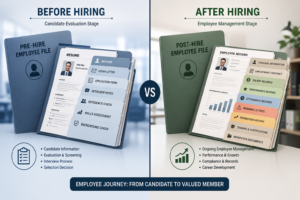
What’s REALLY Inside an Employee File?

By Nandana G S , Digital Marketing Executive , Levelup HR Solutions

Employee documentation is one of the most overlooked yet critical functions in any organisation. While businesses focus on hiring, payroll, and performance, the structure and completeness of employee files often receive minimal attention — until a compliance issue or dispute arises.

A well-maintained employee file is not just a record. It is a legal safeguard, a compliance requirement, and a foundation for effective HR management.

Why Employee Files Matter

Employee files are not administrative formalities. They serve three critical functions:

  • Legal protection — in case of disputes, terminations, or claims
  • Compliance readiness — for labour law inspections and audits
  • Operational clarity — for payroll, performance management, and internal decisions

If it is not documented, it is difficult to defend.

The Core Principle: Structure Over Storage

The problem is not that documents are missing. The problem is that they are unstructured.

A well-maintained employee file should be divided into clear sections, each serving a specific purpose.

1. Pre-Employment Documents

These are collected before or at the time of hiring.

Must include:

  • Resume / CV
  • Job application form (if applicable)
  • Interview evaluation records
  • Offer letter (signed copy)
  • Proof of identity (Aadhaar, PAN, Passport)
  • Address proof
  • Educational certificates
  • Previous employment documents (experience letters, relieving letters)

Why it matters: These documents validate the hiring decision and protect the company from misrepresentation or background-related disputes.

2. Employment Contract & Policy Acknowledgements

This is the legal foundation of employment.

Must include:

  • Appointment letter / employment contract
  • Job description (if separate)
  • Compensation structure (CTC breakup)
  • Signed policy acknowledgements (HR manual, code of conduct, IT policy, leave policy, etc.)
  • Non-disclosure agreement (NDA), if applicable

Why it matters: This section defines the terms of employment. Any ambiguity here becomes a dispute later.

3. Payroll & Statutory Records

This section is often incomplete in SMEs — and that creates compliance risk.

Must include:

  • PAN and bank account details
  • PF (UAN) details
  • ESI registration (if applicable)
  • Salary revision letters
  • Bonus / incentive documentation
  • Tax declarations and proofs
  • TDS computation summaries

Why it matters: Payroll is not just payment — it is a statutory process. Missing or inconsistent records can lead to penalties.

4. Attendance, Leave & Working Records

These records support payroll accuracy and compliance.

Must include:

  • Attendance records (biometric / digital logs)
  • Leave applications and approvals
  • Overtime records (if applicable)
  • Shift schedules (for applicable roles)

Why it matters: These documents support wage calculations and defend the organisation in case of wage or overtime disputes.

5. Performance & Appraisal Records

Performance documentation is critical — especially during promotions, increments, or terminations.

Must include:

  • KPI / KRA definitions
  • Performance reviews and appraisal forms
  • Increment letters
  • Promotion or role change letters
  • Performance improvement plans (PIP), if any

Why it matters: Decisions related to growth or termination must be backed by documented performance — not verbal assessments.

6. Disciplinary & Compliance Records

Most companies either avoid documenting this — or do it inconsistently.

Must include:

  • Warning letters
  • Show-cause notices
  • Investigation reports (if applicable)
  • Employee responses
  • Final disciplinary actions

Why it matters: Without proper documentation, disciplinary actions become legally weak and difficult to defend.

7. Asset & IT Access Records

This is often ignored — until assets go missing.

Must include:

  • Asset allocation records (laptop, phone, ID card, etc.)
  • IT access credentials (system access logs, where applicable)
  • Asset return acknowledgements

Why it matters: Protects company property and ensures accountability during exit.

8. Exit & Full-and-Final Settlement Records

The employee file is not complete until the exit is documented.

Must include:

  • Resignation letter or termination letter
  • Exit interview records
  • Notice period documentation
  • Full-and-final settlement details
  • Relieving letter
  • Experience certificate

Why it matters: Improper exit documentation is one of the most common causes of post-employment disputes.

Common Mistakes SMEs Make

1. Missing documents Offer letters unsigned, policies not acknowledged, or incomplete KYC documents.

2. No updates Salary revisions, promotions, and role changes not documented properly.

3. Scattered storage Documents across emails, WhatsApp, physical files, and desktops.

4. No version control Multiple versions of the same document with no clarity on which is final.

5. Ignoring exit documentation Files closed without proper settlement or documentation.

Manual vs Digital Employee Files

Manual files can work for very small teams. But they come with limitations:

  • Difficult to access
  • Prone to loss or damage
  • No audit trail
  • Hard to scale

Digital employee files provide:

  • Centralised access
  • Better security
  • Easy retrieval
  • Audit readiness
  • Scalability

The key is not just digitisation — but structured digitisation.

Best Practices for Maintaining Employee Files
  • Standardise file structure across all employees
  • Use checklists to ensure completeness
  • Keep documents updated in real-time
  • Maintain confidentiality and access control
  • Digitise with proper folder hierarchy and naming conventions
  • Conduct periodic audits of employee file

Closing Thought

An employee file is not just paperwork.

It is the documented story of the employment relationship — every decision, every change, every obligation.

Well-maintained employee files reduce risk, improve clarity, and strengthen compliance.

Poorly maintained files do the opposite — silently, until it is too late.

The difference is not in how many documents you have. It is in how well they are structured, maintained, and managed.

At Level UP HR Solutions, we help businesses build complete, compliant, and audit-ready employee documentation systems — both manual and digital.

12May

Is Your Company Ready for a Labour Inspection in 2026?

By, Rose Maria Francis

Digital Marketing Executive,

Level Up HR Solutions

Most businesses do not fail labour inspections because they intentionally break the law. They fail because they are unprepared.

A missing register. An outdated policy. An incorrect wage calculation.

Small gaps  with large consequences.

With increasing digitisation and stricter enforcement, labour inspections in 2026 are not just procedural — they are precise, data-driven, and documentation-focused.

This article outlines what inspectors typically look for, where SMEs go wrong, and how to ensure your business is fully prepared.

What Has Changed in Labour Inspections

Labour inspections today are no longer random, paper-based checks.

They are:

  • Data-driven — triggered by filings, complaints, or inconsistencies
  • Digitally supported — cross-verification with PF, ESI, and payroll records
  • Documentation-heavy — emphasis on records, not explanations

The expectation is simple: If it is not documented, it does not exist.

What Inspectors Typically Check

While requirements vary by establishment, most inspections focus on three areas:

1. Employee Documentation
  • Appointment letters issued and signed
  • Employee identity and KYC records
  • Attendance and leave records
  • Wage structure and salary breakup

Risk area: Missing or unsigned documents.

2. Payroll & Statutory Compliance
  • Salary payments aligned with minimum wage laws
  • PF and ESI registration and contributions
  • TDS deductions and filings
  • Bonus calculations and payments

Risk area: Incorrect calculations or delayed filings.

3. Registers & Records
  • Statutory registers (wages, attendance, overtime, etc.)
  • Leave records and holiday lists
  • Inspection registers
  • Digital or physical record maintenance

Risk area: Incomplete or outdated registers.

4. Policies & Workplace Compliance
  • Leave policy
  • Code of conduct
  • POSH compliance (Internal Committee, policy, records)
  • Working hours and overtime compliance

Risk area: Policies exist but are not implemented or documented.

Common Mistakes SMEs Make

1. “We’ll fix it if inspection happens” mindset Compliance cannot be created overnight.

2. Partial documentation Some employees fully documented, others not.

3. Payroll errors Incorrect PF, ESI, or bonus calculations.

4. No audit trail No record of updates, approvals, or changes.

5. Ignoring digital compliance Mismatch between filed data and internal records.

Manual vs Digital Readiness

Many SMEs still rely on:

  • Excel payroll
  • Physical registers
  • Scattered employee files

This creates risk during inspections.

Digitally structured systems provide:

  • Instant access to records
  • Accurate calculations
  • Audit-ready documentation
  • Consistency across all employees

The goal is not just digitisation — but organised, verifiable data.

A Practical Labour Inspection Checklist

If your company is inspection-ready, you should be able to confidently answer “yes” to all of the following:

  • Are all employee files complete and updated?
  • Are appointment letters issued and signed?
  • Are payroll records accurate and consistent with filings?
  • Are PF, ESI, and TDS properly calculated and filed?
  • Are statutory registers maintained and updated?
  • Are policies documented and acknowledged by employees?
  • Is your data consistent across systems and filings?

If the answer to any of these is “no” — there is a gap.

How to Prepare — The Right Approach

1. Conduct an internal HR audit Identify gaps before an inspector does.

2. Standardise documentation Ensure consistency across all employees.

3. Digitise with structure Centralised, accessible, and secure records.

4. Align payroll with compliance No manual approximations — only accurate calculations.

5. Train your HR/admin team Awareness is as important as documentation.

6. Review regularly Compliance is ongoing, not one-time.

The Cost of Being Unprepared

Labour inspections do not just result in penalties.

They can lead to:

  • Financial liabilities
  • Legal complications
  • Operational disruption
  • Reputation damage

In contrast, a well-prepared company handles inspections with confidence and clarity.

Closing Thought

Labour inspection readiness is not about fear. It is about discipline.

The businesses that pass inspections smoothly are not the ones scrambling at the last moment — they are the ones that treat compliance as a continuous process.

Because when everything is documented, updated, and aligned — inspection is no longer a risk. It is just a formality.

At Level UP HR Solutions, we help businesses audit, structure, and manage HR compliance systems to ensure they are always inspection-ready.

05May

Update These HR Docs Before 2026 Hits

By, Rose Maria Francis

Digital Marketing Executive

Level Up HR Solutions

As India moves toward implementing its consolidated labour framework, much of the conversation has focused on payroll restructuring and cost implications. However, an equally criticala nd often overlooked area is HR documentation.

Under the new regime, compliance will not be assessed based on intent or internal understanding. It will be evaluated through documented evidence that is consistent, structured, and verifiable. For businesses, this represents a shift from informal or fragmented documentation practices to a system that must withstand regulatory scrutiny.

The Shift: From Documentation to Defensibility

The upcoming labour codes standardise definitions, expand coverage, and increase reliance on digital records. As a result, documentation is no longer a procedural requirement—it is a compliance asset.

In practical terms, this means:

  • Employment terms must align with statutory definitions
  • Payroll structures must match documented agreements
  • Records must be consistent across all compliance filings
  • Data must be traceable and readily accessible

Any inconsistency across these elements can trigger deeper inspection and potential liability.

Key HR Documents That Require Immediate Review

1. Appointment Letters

Appointment letters are often treated as basic onboarding documents. Under the new framework, they become legally significant.

They must clearly define:

  • Wage structure in line with statutory definitions
  • Employment classification (permanent, fixed-term, contractual)
  • Working hours and conditions
  • Leave entitlements
  • Termination and notice provisions

A mismatch between appointment terms and actual payroll practices can create immediate compliance exposure.

2. Employment Contracts

Generic or outdated employment contracts are no longer sufficient.

Contracts should be updated to reflect:

  • Role clarity and reporting structure
  • Compensation aligned with revised wage definitions
  • Statutory obligations and compliance clauses
  • Confidentiality, conduct, and dispute provisions

In the event of disputes or inspections, these contracts form the foundation of your legal and operational defence.

3. Salary Structure Documentation

The revised definition of wages introduces one of the most significant changes.

In most cases: Basic pay and dearness allowance must constitute at least 50% of total remuneration.

This requires:

  • Redesign of salary structures
  • Reclassification of allowances
  • Alignment of documentation with actual disbursements

Failure to reflect these changes accurately can lead to inconsistencies in provident fund, gratuity, and bonus calculations.

4. Wage Registers and Payroll Records

The emphasis on standardisation and traceability increases the importance of payroll documentation.

Businesses must ensure:

  • Accurate and up-to-date wage registers
  • Digitally maintained payroll records
  • Consistency across statutory filings (PF, ESI, tax)

Discrepancies between payroll data and statutory submissions are among the most common triggers for regulatory scrutiny.

5. Attendance and Working Hours Records

Informal tracking mechanisms will not meet compliance expectations under the new framework.

Required improvements include:

  • Reliable attendance systems
  • Proper recording of working hours and overtime
  • Documentation of shift patterns where applicable

These records must correlate directly with wage payments and statutory calculations.

6. Leave Policies and Records

Leave management must move from informal tracking to structured documentation.

This involves:

  • Clearly defined leave policies
  • Consistent application across employees
  • Proper maintenance of leave records

Inadequate documentation in this area can lead to disputes and compliance gaps.

7. Contractor and Vendor Documentation

Compliance exposure is no longer limited to direct employees.

Businesses must review:

  • Contractor agreements
  • Vendor compliance declarations
  • Payment and engagement records

Non-compliance within the vendor ecosystem can extend liability to the principal employer.

8. Digital Record Maintenance

A defining feature of the new labour framework is the shift toward digital compliance.

Organisations must ensure:

  • Secure and structured digital storage of records
  • Ease of retrieval during inspections
  • Consistency across systems and filings

Paper-based or fragmented systems increase the risk of incomplete or inconsistent data.

Common Risk Areas

Many organisations underestimate the risk not because of lack of awareness, but due to timing.

Typical assumptions include:

  • Documentation can be updated when required
  • Existing formats are largely sufficient
  • Minor adjustments will ensure compliance

In reality, by the time documentation is requested:

  • Inconsistencies are already visible
  • Historical gaps are harder to correct
  • Exposure has already increased
A Structured Approach to Preparation

Effective preparation requires a coordinated review across:

  • Documentation: Updating contracts, letters, and registers
  • Payroll: Aligning salary structures with statutory definitions
  • Compliance Records: Reconciling filings across PF, ESI, and tax
  • Processes: Strengthening attendance, leave, and employee lifecycle tracking
  • Vendors: Assessing third-party compliance

This is not a one-time exercise but a system-level alignment.

Conclusion

Under the 2026 labour framework, compliance will depend less on isolated filings and more on the consistency of your overall HR system.

Documentation will play a central role in that system—not as a formality, but as verifiable evidence of compliance.

Organisations that address these requirements proactively will not only reduce regulatory risk but also improve operational clarity and audit readiness.

Those that delay may find that the cost of correction—financial and operational—is significantly higher.

India’s labour law reforms aren’t just a legal shift—they’re a wake-up call for businesses to modernize their HR frameworks. If your HR documents haven’t been revisited recently, now is the time to act. Delays can lead to compliance risks, financial penalties, and operational disruptions.

Start with a simple audit. Update what matters. And ensure your policies reflect not just the law—but the future of work.

About Level UP HR Solutions Level UP HR Solutions supports organisations in aligning HR documentation, payroll structures, and compliance systems with evolving labour regulations.